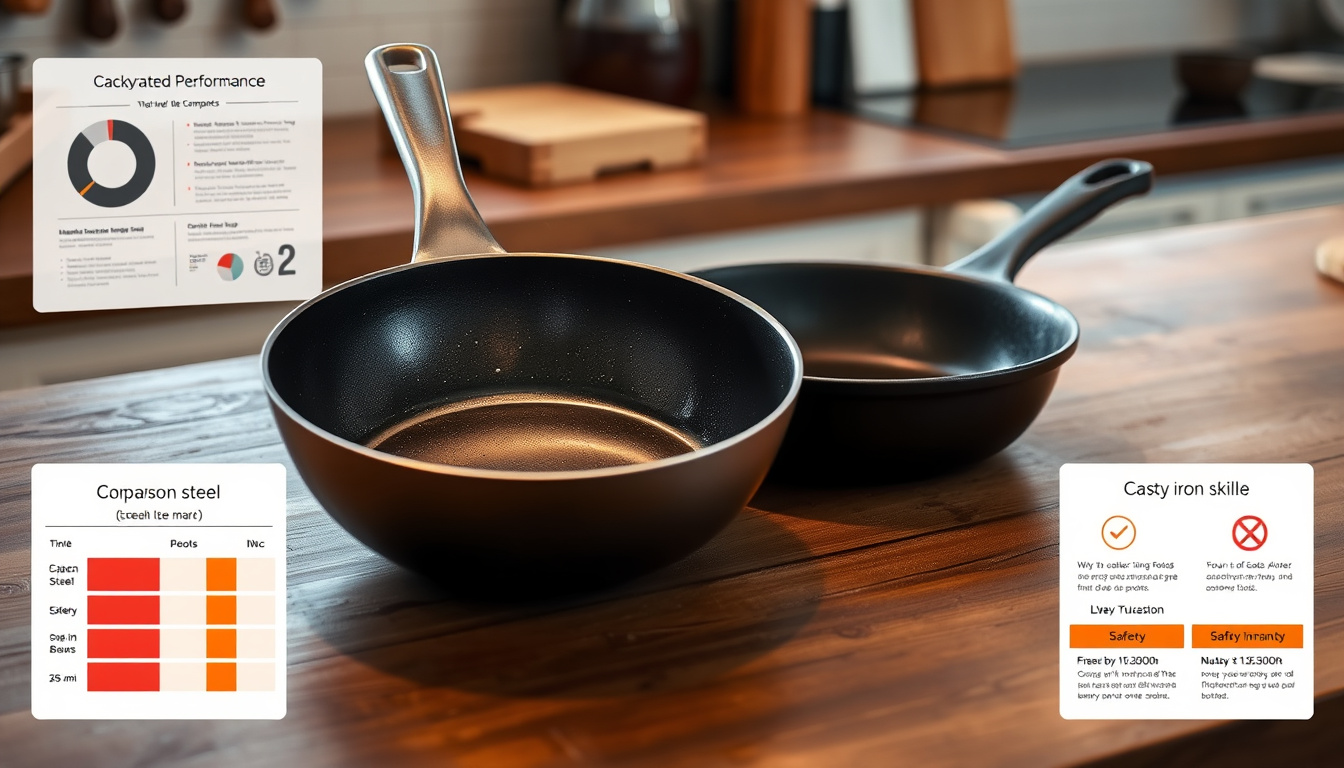
If you’ve been eyeing carbon steel pans but can’t decide whether they’re worth the effort, you’re in good company. Plenty of home cooks across Ireland have stood in the cookware aisle wondering whether to go with seasoned carbon steel or stick with familiar cast iron. The good news: once properly seasoned, a carbon steel pan delivers genuine nonstick performance without any chemical coatings — and it’s lighter, too.
Popular Sizes: 25-28 cm · Key Brands: de Buyer, IKEA VARDAGEN, Samuel Groves · Heat Tolerance: Up to 1200°F · Nonstick Method: Polymerized oil seasoning
Quick snapshot
- Seasoned carbon steel delivers genuine nonstick cooking (Misen)
- Carbon steel weighs roughly half what cast iron does (Made In)
- All three materials work on induction hobs (Irish Examiner)
- Long-term iron leaching levels from carbon steel under extended acidic cooking
- Quantified durability lifespan comparisons across brands
- Specific Irish retail pricing for premium models
- Irish interest in toxin-free cookware peaked around 2019 with Living Lightly in Ireland guidance
- Irish Examiner highlighted stainless and cast iron as practical choices for smaller kitchens
- Brands like Le Creuset and Fissler expand stainless offerings for Irish kitchens
- Carbon steel adoption growing among home cooks seeking nonstick alternatives
The specifications below summarize verified material properties and performance characteristics for carbon steel pans sold in Ireland.
| Specification | Value |
|---|---|
| Material Composition | 99% iron, 1% carbon alloy |
| Typical Sizes | 25 cm, 28 cm |
| Heat Resistance | Up to 1200°F (no coating limits) |
| Nonstick Method | Polymerized oil seasoning |
| User Durability Note | Bombproof with rough use |
What are the downsides of carbon steel pans?
Carbon steel pans earn their reputation for durability, but they demand attention in ways stainless simply doesn’t. The main trade-off is corrosion risk: without proper drying after washing, rust can develop quickly — something that rarely concerns cast iron owners who rely on that material’s seasoned base layer.
Rust and corrosion risks
Carbon steel reacts with moisture and oxygen far more readily than stainless steel. After washing, even brief air-drying can leave surface moisture that promotes oxidation. The fix is straightforward — dry immediately and apply a thin coat of oil — but it requires habits that casual cooks may find tedious. Kulina.ie notes that both carbon steel and cast iron require seasoning to prevent rust and maintain their nonstick properties.
Maintenance demands
Unlike pre-seasoned cast iron, which often arrives ready to use, most carbon steel pans from brands like de Buyer ship unseasoned. This means your first few cooks involve building up that polymerized oil layer yourself. Borough Kitchen explains that cast iron pans typically come pre-seasoned with a rougher surface that masks minor imperfections, while carbon steel’s smoother finish demands more careful initial seasoning.
Is it healthy to cook in a carbon steel pan?
When it comes to cookware safety, the absence of chemical coatings matters to plenty of cooks. Carbon steel contains no PTFE, no PFOA, and no synthetic nonstick layers — a point that resonates with anyone who’s read about the concerns surrounding conventional nonstick coatings.
Safety comparisons
Unlike some nonstick coatings that degrade at moderate temperatures, carbon steel handles extreme heat without releasing harmful fumes. Le Creuset Ireland highlights that 3-ply stainless steel heats quickly and evenly for everyday cooking, but stainless remains non-reactive only if the chromium oxide layer stays intact — a condition not always met with damaged or degraded cookware.
Non-toxic properties
Uncoated cast iron, stainless steel, and carbon steel all appear on toxin-free recommendation lists for Irish kitchens. Living Lightly in Ireland advises rotating your cookware to limit metal leaching exposure, since most materials except glass can contribute trace metals to food during cooking.
Why is food sticking to my carbon steel pan?
Food sticking to a carbon steel pan almost always traces back to incomplete seasoning or insufficient preheating. The polymerized oil layer hasn’t fully developed, or the pan hasn’t reached the right temperature before the food went in.
Common causes
Most sticking problems stem from three issues: inadequate seasoning build-up, insufficient preheat time, or cooking with wet protein that cools the surface upon contact. Misen notes that carbon steel requires seasoning just like cast iron but offers better nonstick results once the surface smooths out over time.
Fixing steps
To restore nonstick performance, clean the pan thoroughly, dry it completely, then apply a thin layer of high-smoke-point oil (flaxseed, grapeseed, or vegetable shortening work well). Heat the pan until smoking, let it cool, and repeat two or three times. This rebuilds the polymerized layer that makes carbon steel genuinely nonstick.
Improperly seasoned carbon steel behaves like bare metal — proteins bond on contact, leaving fond instead of a sear. A well-seasoned pan browns food effortlessly.
Do professional chefs use carbon steel?
Walk through most commercial kitchens and you’ll spot carbon steel pans hanging from hooks or stacked on shelves. Professional cooks gravitate toward them for specific reasons tied to performance and practicality that home kitchens rarely replicate.
Chef preferences
Commercial kitchens value speed and control. Misen explains that carbon steel excels at sautéing and stir-frying due to its lighter weight and sloped sides — a combination that makes tossing food more manageable and response time faster than cast iron permits.
Performance reasons
Carbon steel heats and cools faster than cast iron, offering better temperature control when transitioning between tasks. Irish Examiner reports that cast iron works on all hobs but requires regular seasoning, while stainless steel remains easier to maintain across everyday cooking.
Professional kitchens use carbon steel hard and often reseason daily — habits that most home cooks won’t maintain without effort.
Carbon steel pan vs cast iron
The choice between carbon steel and cast iron hinges on your cooking priorities and how much routine maintenance you’re willing to accept. Both are ferrous cookware that benefits from seasoning, but their characteristics differ enough to suit different cooking styles.
Key differences
Carbon steel weighs roughly half what cast iron does, making it significantly easier to handle — especially for larger skillet sizes. Made In confirms this weight ratio, noting that carbon steel handles up to 1200°F without issue. Cast iron, meanwhile, excels at searing steaks and shallow-frying due to superior heat retention. Misen specifically highlights cast iron’s advantage in tasks requiring consistent high temperatures.
Heat response tells a similar story. Carbon steel heats and cools faster than cast iron, offering better temperature control when you need quick adjustments. Kulina.ie documents this difference, noting that carbon steel’s quicker thermal cycling makes it more responsive during cooking.
Vs stainless steel
Stainless steel occupies a different niche entirely. It lacks natural nonstick properties, so food can stick if not properly preheated. Kulina.ie confirms this trade-off. However, Bertazzoni Ireland notes that stainless steel is durable, hygienic, and easy to clean — advantages that appeal to cooks prioritizing convenience over seasoning rituals.
The implication: if you prioritize low-effort maintenance, stainless wins; if you want genuine sear-and-release without coatings, carbon steel delivers — provided you maintain the seasoning.
Carbon steel pan comparison
Three materials dominate Irish kitchen cookware discussions: carbon steel, cast iron, and stainless steel. Each delivers distinct advantages depending on your cooking habits, maintenance tolerance, and budget.
The comparison table below maps core features side by side to clarify how each material performs across everyday kitchen demands.
| Feature | Carbon Steel | Cast Iron | Stainless Steel |
|---|---|---|---|
| Weight | Half of cast iron | Heavy (fragile) | Moderate |
| Heat Response | Fast heating/cooling | Slow but steady | Fast (3-ply) |
| Nonstick (seasoned) | Excellent when seasoned | Good when seasoned | None naturally |
| Maintenance | Dry + oil after wash | Season regularly | Dishwasher safe |
| Reactivity | Reacts with acids | Reacts with acids | Non-reactive |
| Induction Compatible | Yes | Yes | Yes |
| Typical Heat Limit | Up to 1200°F | High heat capable | High heat capable |
Carbon steel pan specifications
Carbon steel pans share a common composition but vary in thickness, handle design, and finishing — details that affect how they perform in real kitchens.
The specifications table below consolidates verified material data and sourced performance claims for reference during purchase decisions.
| Specification | Detail | Source |
|---|---|---|
| Composition | 99% iron, 1% carbon | Dalstrong |
| Weight vs Cast Iron | Approximately half | Made In |
| Maximum Heat | 1200°F | Made In |
| Pre-seasoned | Usually not (varies by brand) | Borough Kitchen |
| Induction Compatible | Yes | Irish Examiner |
| Typical Sizes | 25 cm, 28 cm | Industry standard |
| Seasoning Required | Yes — build polymerized layer | Misen |
| Acidic Food Safety | Use caution (reactive) | Kulina.ie |
Upsides
- Genuine nonstick when seasoned (no chemicals)
- Lightweight — easier to handle than cast iron
- Fast heat response for quick temperature adjustments
- Handles extremely high heat without coating degradation
- Develops smoother surface than cast iron over time
- Works on all hob types including induction
Downsides
- Rusts without proper drying and oiling
- Requires initial seasoning before first serious use
- Reacts with acidic foods (tomatoes, vinegar)
- Not dishwasher safe — hand wash only
- Food sticks if not properly preheated
- Less heat retention than cast iron for certain tasks
How to fix sticky carbon steel pan
A sticky carbon steel pan isn’t ruined — it’s just asking for attention. Restoring nonstick performance takes an hour or two and requires only basic supplies.
- Scrub the pan with warm water and a scrub brush or abrasive pad to remove any loose oil residue.
- Dry completely with a towel, then place on a burner over medium-high heat until all moisture evaporates.
- Apply a thin coat of high-smoke-point oil (flaxseed oil works best, but vegetable shortening or grapeseed oil are acceptable alternatives) across the entire cooking surface.
- Heat until the oil begins smoking, then remove from heat and let cool completely.
- Repeat this process two to three times to build a proper polymerized layer.
- After the final coat cools, wipe away excess oil — the pan should appear even and slightly glossy.
- Cook on it within a day or two to “set” the seasoning with actual food use.
The pattern: fresh polymerized oil needs heat cycles and actual cooking to fully cure. Rushing this process produces a gummy surface rather than the smooth, slick finish you want.
Avoid cooking acidic foods during the first few uses after reseasoning — tomato sauces, wine-based dishes, and citrus can strip the fresh polymerized layer before it fully cures.
What the research confirms — and what it doesn’t
When evaluating cookware claims, distinguishing between established facts and areas of genuine uncertainty helps you make informed decisions rather than relying on marketing language.
Confirmed facts
- Seasoned carbon steel delivers genuine nonstick cooking without chemical coatings
- Carbon steel weighs roughly half what cast iron does
- All three materials work on induction hobs common in Irish kitchens
- Carbon steel contains 99% iron and 1% carbon
- Proper seasoning builds a polymerized oil layer that prevents sticking
- Carbon steel reacts with acidic foods similar to cast iron
What remains unclear
- Long-term iron leaching levels during extended acidic cooking sessions
- Quantified durability comparisons across specific brands available in Ireland
- Precise pricing data for premium carbon steel models at Irish retailers
- User satisfaction data from Irish forums or retailer reviews
What people say
Carbon steel pans are significantly lighter, making them easier to handle, especially for larger sizes.
— Kulina.ie (Irish Cookware Guide)
Cast iron excels in tasks requiring consistent high temperatures, such as searing steaks.
— Misen (Cookware Brand)
Stainless steel is easy to maintain and works with all hobs including induction.
— Irish Examiner (Local Publication)
Rotate your cookware to limit your exposure to any particular toxin.
Carbon steel demands seasoning effort upfront, but rewards you with genuine chemical-free nonstick performance. Stainless steel stays convenient but never achieves that same natural release without coatings.
Summary
Carbon steel pans occupy a specific niche in Irish kitchens — they’re lighter and more responsive than cast iron, deliver real nonstick results without chemical coatings, and handle the high heat that cast iron manages. The catch is maintenance: drying immediately, applying oil regularly, and reseasoning when sticking returns. For cooks who’d rather not deal with seasoning rituals, stainless steel remains the more convenient choice despite its lack of natural nonstick properties. For those seeking that genuine sear-and-release performance without PTFE exposure, carbon steel earns the extra effort.
Related reading: 5 Weird Signs of Iron Deficiency
Carbon steel pans deliver cast iron’s searing power at half the weight, building nonstick prowess through seasoning as covered in this carbon steel pan seasoning guide.
Frequently asked questions
How do you season a carbon steel pan?
Apply a thin coat of high-smoke-point oil (flaxseed, grapeseed, or vegetable shortening), heat until smoking, let cool completely, then repeat two to three times. Cook actual food on it within a day or two to set the seasoning.
Can carbon steel pans go in the oven?
Yes — most carbon steel pans tolerate oven temperatures up to 1200°F. Always remove silicone or plastic handle inserts before oven use, and use oven mitts as handles get extremely hot.
What oil is best for carbon steel pans?
Flaxseed oil polymerizes most reliably, but grapeseed oil and vegetable shortening work well as alternatives. Avoid olive oil and butter — their low smoke points make them poor choices for seasoning.
Are carbon steel pans induction compatible?
Yes — carbon steel works on all hob types including induction, gas, electric, and ceramic. The magnetic iron content ensures reliable induction heating.
How to clean a carbon steel pan?
Wash with hot water and a scrub brush immediately after cooking. Avoid soap unless necessary. Dry thoroughly with a towel, then apply a thin coat of oil before storing. Never leave a carbon steel pan wet or it will rust.
Can carbon steel pans be used for acidic foods?
Use caution — tomatoes, vinegar, wine, and citrus can strip the seasoning and leach iron. If cooking acidic foods regularly, stainless steel handles them without concern.
What temperature can carbon steel pans withstand?
Carbon steel handles temperatures up to approximately 1200°F without degradation. This far exceeds typical cooking needs and rivals what cast iron can manage.

Rachel Bennett leads fact-checking, source verification and corrections at Coast Pulse.