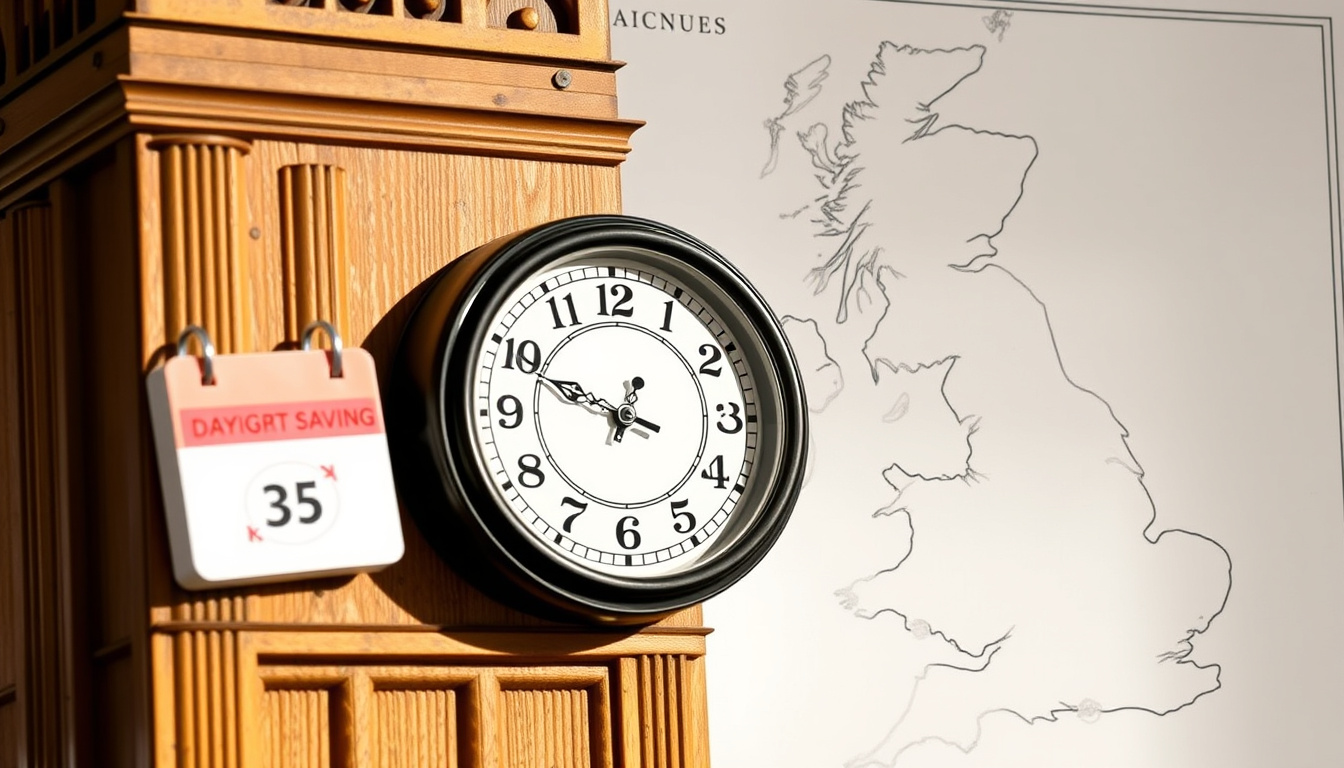
If you’ve ever found yourself mentally calculating the difference between your local time and UK time while scheduling a call, you’re not alone. The UK’s half-yearly dance between British Summer Time (BST) and Greenwich Mean Time (GMT) can be confusing—but it follows a predictable rhythm. Right now, London is on BST at 10:03 AM, and we’ll walk you through exactly when that changes, why it happens at 2am, and how Ireland fits into the picture.
Current time in London (BST): 10:03:08 AM, Wednesday, May 6, 2026 ·
Time zone now: British Summer Time (UTC +1) ·
Next clock change (back): October 25, 2026 at 2:00 AM BST ·
Next clock change (forward): March 28, 2027 at 1:00 AM GMT
Quick snapshot
- UK currently on British Summer Time (UTC +1) until October 25, 2026 (GOV.UK, the UK government’s official portal)
- Ireland shares the same time zone year-round (Wikipedia)
- Potential future abolition of daylight saving time remains under debate, with no UK decision yet (Serious Readers, a UK lighting specialist)
- Check your devices update automatically; manual clocks need adjusting on October 25 (Royal Museums Greenwich, the home of GMT)
The table below lays out the core facts at a glance.
| Label | Value |
|---|---|
| Current time in London | 10:03:08 AM BST, May 6, 2026 |
| Current time zone | British Summer Time (UTC +1) |
| Standard time zone | Greenwich Mean Time (UTC +0) |
| Next clock change (back) | October 25, 2026 at 2:00 AM BST |
| Next clock change (forward) | March 28, 2027 at 1:00 AM GMT |
What time is it in the UK just now?
As of this snapshot, the current local time in London is 10:03:08 AM on Wednesday, May 6, 2026. The UK is observing British Summer Time (BST), which is UTC +1. If you’re using a 12-hour clock, it’s 10:03 AM — the afternoon time would show as 10:03 PM later today. For those who need seconds, the exact time is 10:03:08 AM BST, as tracked by atomic clocks at the National Physical Laboratory, the UK’s official timekeeping authority.
Current local time in London
The time in London is the same across all parts of the UK — there is no time zone difference between England, Scotland, Wales, or Northern Ireland. All follow BST in summer and GMT in winter. The current reading comes from timeanddate.com, a neutral time tracking service.
Is Irish time the same as UK time?
A common question, especially for people traveling between the two islands. The short answer: yes, Ireland and the UK use identical time zones year-round.
Ireland uses Irish Standard Time (IST) in summer, which is also UTC +1, and GMT in winter — exactly the same as the UK’s BST and GMT. Both countries change clocks on the same dates, at the same local times. Wikipedia confirms that Ireland aligns with the UK under the EU’s former Summer Time directive (2000/84/EC).
The implication: If you’re in Dublin and calling London, there’s zero time difference. The long-running remark “Ireland is one hour ahead” is a myth — it applies to some other countries, not Ireland.
Time zone comparison: UK vs Ireland
Two countries, one time zone — here’s how they match up:
| Feature | United Kingdom | Ireland |
|---|---|---|
| Summer time zone | British Summer Time (UTC +1) | Irish Standard Time (UTC +1) |
| Winter time zone | Greenwich Mean Time (UTC +0) | Greenwich Mean Time (UTC +0) |
| Clock change dates | Last Sunday March / Last Sunday October | Same (aligned with EU directive) |
| Actual time difference | None | None |
The pattern is clear: there is no time difference to account for when traveling between the two countries.
When do the clocks change in the UK?
The UK changes clocks twice a year: forward in spring, back in autumn. In 2026, the dates are confirmed on GOV.UK, the UK government’s official portal:
- Spring forward to BST: Sunday, March 29, 2026 at 1:00 AM GMT (clocks go forward to 2:00 AM BST)
- Fall back to GMT: Sunday, October 25, 2026 at 2:00 AM BST (clocks go back to 1:00 AM GMT)
The change time of 1am GMT (spring) and 2am BST (autumn) is intentional. According to the University of East London, which studies timekeeping impacts, these times were chosen because they fall during the lowest activity period — most people are asleep, minimizing disruption to train schedules, pub closing times, and business operations. The autumn switch at 2am BST specifically avoids interfering with late-night transport and weekend bar hours.
UK clock change dates 2025–2027
Four changes, two directions, one pattern:
| Date | Event |
|---|---|
| October 26, 2025 | Clocks went back to GMT (most recent autumn change) |
| March 29, 2026 | Clocks went forward to BST (most recent spring change) |
| October 25, 2026 | Clocks go back to GMT at 2am BST |
| March 28, 2027 | Clocks go forward to BST at 1am GMT |
The UK’s 69 million people gain an extra hour of daylight in the evening during BST — but lose it in the morning. For commuters and school runs, that means darker starts in spring; for evening dog walkers, lighter evenings until autumn. The government sees this as the optimal balance, as confirmed in their 2026 statement on no plan to change the system.
The implication: BST gives more evening light but costs morning brightness, a trade-off the government considers acceptable.
Why do clocks go back at 2am?
The 2am standard might seem arbitrary, but it has roots in early 20th-century transport and social patterns. According to the University of East London’s analysis, the time was chosen because:
- It falls after most bars and pubs have closed (preventing confusion with drinkers leaving at 1am)
- Train schedules were already low-traffic at that hour
- It minimized disruption to church services and early shift workers
The choice of 2am also synchronized with the original British Summer Time legislation from 1916, which set the pattern still used today (Wikipedia, citing the Summer Time Act and the current Summer Time Order 2002).
Does it affect sleep?
Yes — the spring change means losing one hour of sleep on that Sunday morning. The autumn change means gaining one hour. The mnemonic “spring forward, fall back” from Royal Museums Greenwich, the home of GMT, helps remember the direction. For those sensitive to sleep disruption, the NHS sleep advice recommends adjusting gradually in the days leading up to the change.
Timeline: UK clock changes (2025–2027)
A quick chronological view of recent and upcoming changes:
| Date | Event |
|---|---|
| October 26, 2025 | Clocks back to GMT (autumn change) |
| March 29, 2026 | Clocks forward to BST (spring change) |
| October 25, 2026 | Clocks back to GMT at 2am BST |
| March 28, 2027 | Clocks forward to BST at 1am GMT |
The 2026 spring change has already passed; the next event is the autumn change on October 25. Set a reminder to adjust any non-digital clocks—including Big Ben and 2,000 other Westminster clocks, which are manually wound during the change, as noted by Visit London, the city’s official tourism body.
The pattern confirms a steady rhythm: residents can prepare for October 25 as the next key date.
Confirmed facts vs. what’s unclear
Confirmed facts
- UK uses BST (UTC +1) from last Sunday March to last Sunday October, GMT (UTC +0) the rest of the year
- Ireland observes the same time as the UK year-round
- Clocks change at 1am GMT (spring) / 2am BST (autumn)
- Next change: October 25, 2026 at 2am BST
- No government plans to abolish DST as of early 2026
What’s unclear
- Future of daylight saving in the UK remains under debate in EU/UK contexts; no formal decision expected soon
Steps: How to convert your local time to UK time
- Check your current time zone offset relative to UTC.
- If the UK is on BST (March–October), add 1 hour to UTC. For GMT, add 0.
- Use online converters like timeanddate.com’s time zone converter.
- Set your digital devices to update automatically — most will handle the change.
Quotes from the experts
“When do the clocks change?”
— National Physical Laboratory, the UK’s official timekeeping authority, on their guidance page
“British Summer Time has been observed in the UK since 1916, following the Summer Time Act.”
— House of Commons Library, the UK Parliament’s research arm
“The current local time in London is 10:03:08 AM BST, based on atomic clock data.”
— timeanddate.com, a neutral global time tracking service
Related reading: Daylight Savings Victoria 2026 · Is Mercury in Retrograde
Frequently asked questions
Is the UK currently in GMT or BST?
The UK is currently in British Summer Time (BST), UTC +1. It will switch to GMT on October 25, 2026.
Does the UK have multiple time zones?
No, the entire United Kingdom uses a single time zone: GMT in winter, BST in summer.
When does British Summer Time 2026 start?
BST started on March 29, 2026. The next start is March 28, 2027.
Why is UK time called BST in summer?
BST stands for British Summer Time, a daylight saving period that advances clocks by one hour from March to October.
What countries share the same time zone as the UK?
Ireland, Portugal (winter), Iceland, and the Canary Islands share the same time zone pattern as the UK.
How do I convert my local time to UK time?
If the UK is on BST: subtract 5 hours from Eastern Time, 1 hour from Central European Time. Use an online converter for precise calculation.
Do all parts of the UK use the same time?
Yes, England, Scotland, Wales, and Northern Ireland all use BST in summer and GMT in winter.

Rachel Bennett leads fact-checking, source verification and corrections at Coast Pulse.