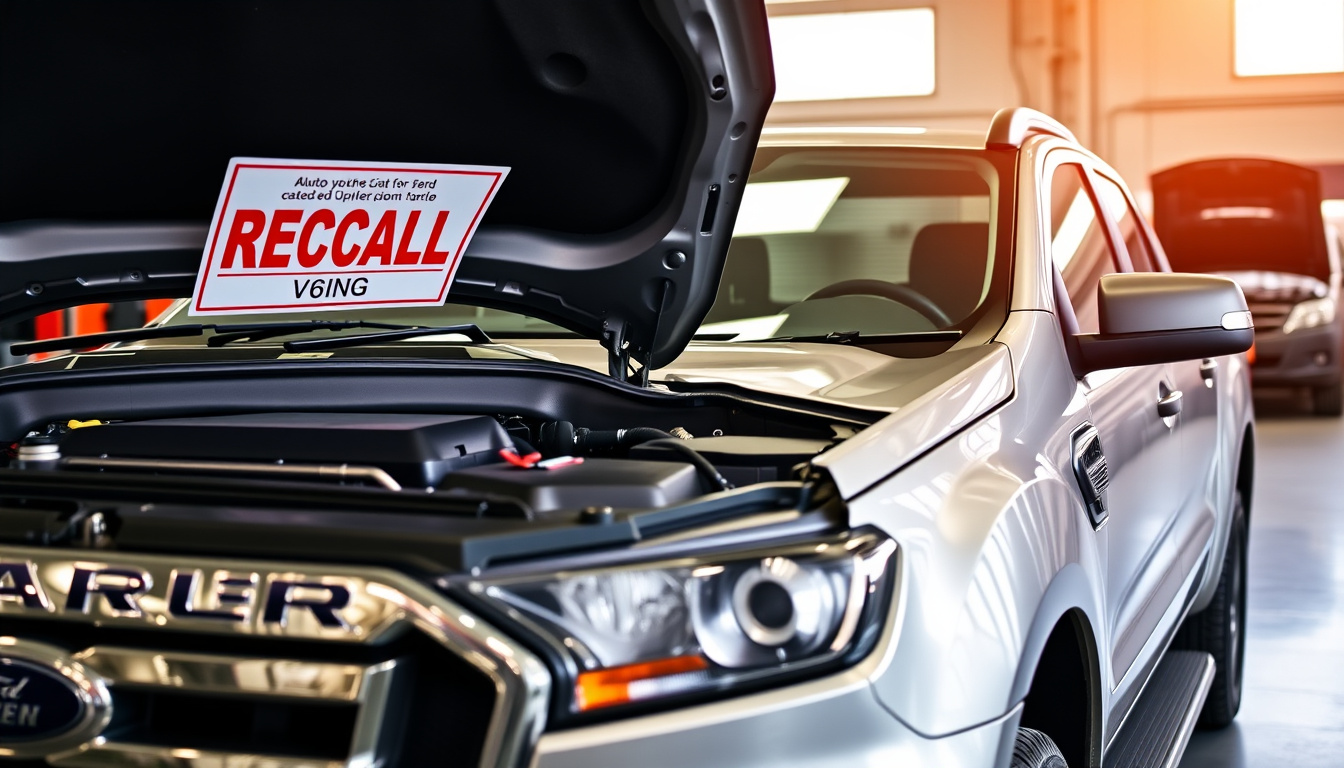
If you own a Ford Ranger with the 3.0-litre V6 turbo-diesel, you need to know about a safety recall making the rounds in Australia and Southern Africa right now. Ford has identified a manufacturing defect in the left-hand camshaft sprocket that can cause the engine to stall without warning — and owners of affected vehicles built between 2022 and 2025 are being offered free repairs at authorised dealerships. Here’s what you need to check and do next.
Affected Models: 2022-2025 Ford Ranger and Everest with 3.0L V6 diesel ·
Issue: Left-hand camshaft sprocket fracture ·
Risk: Engine stall and loss of motive power ·
Recall Notice: REC-006341 in Australia
Quick snapshot
- Camshaft sprocket fracture (Australian Government Vehicle Recalls)
- 13,490 units affected in Australia (Australian Government Vehicle Recalls)
- Free dealer repair offered (Drive.com.au)
- Exact global vehicle count beyond Australia and Southern Africa
- Whether recall links to V6 engine discontinuation decision
- Owner notification completion rates
- Affected vehicles built: June 2022 – March 2025
- Recall announced: May 2025 (Australia)
- Southern Africa expansion: 2025
- Owners should check VIN via official recall checker
- Dealer inspections and repairs underway
- Monitor for further recall expansions
| Detail | Information |
|---|---|
| Recall ID | 25S39 / REC-006341 |
| Engine | 3.0L V6 turbo-diesel Lion |
| Defect | Left-hand camshaft sprocket may fracture |
| Consequence | Sudden engine stall and loss of motive power |
| Fix | Dealer replacement (free of charge) |
| Australia affected units | 13,490 |
| Southern Africa affected units | 1,050 (SA 995, Botswana 17, Namibia 34, Swaziland 4) |
What is the problem with the Ford Ranger 3.0 V6 diesel engine?
Ford has confirmed a manufacturing defect in the left-hand camshaft sprocket of the 3.0-litre Lion turbocharged diesel V6 engine. Under certain conditions, this sprocket can fracture, causing the engine to stall without prior warning. The Australian Government’s Vehicle Recalls database classifies the hazard as a sudden loss of motive power that increases the risk of an accident, potentially resulting in serious injury or death.
Camshaft sprocket defect details
The camshaft sprocket is a critical component that synchronises valve timing. When it fractures, the engine loses drive to the camshafts, causing immediate stall. According to Ford Motor Company of Southern Africa’s official recall notice, the fracture occurs in affected vehicles where the sprocket was manufactured with the defect.
Risk of engine stall
The Australian recall notice is blunt: a sudden loss of motive power whilst driving increases accident risk. The danger is amplified at highway speeds or when towing — situations where losing engine power without warning is particularly hazardous. Ford Australia notes that no accidents had been reported from this defect as of June 2025, but the potential consequences are severe enough to trigger a recall.
Which Ford Rangers are being recalled?
The recall covers Ford Ranger and Everest models fitted with the 3.0-litre V6 turbo-diesel engine built during a specific production window. According to the official Australian recall record, affected vehicles span model years 2022 through 2025, with production dates running from June 2022 through March 2025.
Model years and variants
In Australia, the recall affects Ranger variants including XLT, Wildtrak, Sport, and Platinum — all in the 3.0L V6 turbo-diesel configuration. The Everest SUV is similarly affected, with Sport, Wildtrak, and Platinum trims listed. The Drive.com.au publication notes that the full VIN list for all 13,490 Australian vehicles has been published, allowing owners to verify their specific unit.
Geographic scope
Australia is the primary market, with 13,490 vehicles affected — the largest count of any region so far. Ford Motor Company of Southern Africa has separately recalled 1,050 units built within the same timeframe, split across South Africa (995 vehicles), Botswana (17), Namibia (34), and Swaziland (4). Importantly, as of early June 2025, there is no equivalent recall for the 3.0L diesel V6 in the United States. That market has a separate, unrelated 2024 Ranger recall for 2.7L EcoBoost V6 engines dealing with a fuel vapor leak — a completely different issue.
The recall spans three model years and two vehicle lines, but the common thread is simple: any Ranger or Everest built between mid-2022 and early 2025 with the 3.0 V6 diesel is potentially affected. The geographic clusters (Australia and Southern Africa) suggest production-line issues limited to specific manufacturing periods.
How do I find out if my Ford Ranger has a recall?
Ford is contacting affected owners in writing, but the most reliable way to check is to verify your vehicle’s VIN (Vehicle Identification Number) directly through official channels. This takes just a few minutes and removes any guesswork.
Official recall checkers
In Australia, Ford owners can check their recall status via the Australian Government Vehicle Recalls portal or through Ford Australia’s own recall checker. Both systems accept your 17-character VIN and will confirm whether your vehicle falls under campaign 25S39 or REC-006341. The official government site also provides the complete VIN list as a downloadable CSV for those who want to cross-reference manually.
Steps to verify VIN
- Locate your VIN — found on the driver’s door jamb sticker, bottom of the windscreen, or registration documents
- Visit vehiclerecalls.gov.au and enter your VIN
- If flagged, contact an authorised Ford dealer to schedule a free inspection
- Australian owners can also call the Ford Customer Relationship Centre on 133 673 for assistance
Checking your VIN costs nothing and takes under two minutes. If your Ranger or Everest has the 3.0L V6 diesel and was built between 2022 and 2025, it is worth verifying — even if you have not yet received a letter from Ford. Dealers are completing inspections and repairs at no cost to owners.
What are common problems with Ford Ranger V6?
Beyond this recall, the 3.0-litre Lion V6 turbo-diesel has a mixed reputation in the Ford Ranger community. Forum discussions on Ranger6G note that camshaft and crankshaft snapping issues have appeared in Lion V6 engines since production began in 2003, though the current recall focuses specifically on the left-hand camshaft sprocket in 2022-2025 vehicles.
Beyond the recall
Owners have reported bearing failures and oil consumption issues in higher-mileage Lion V6 engines. These problems are separate from the current recall and typically emerge in engines with higher kilometrage or older variants. The recall does not appear to address these broader concerns — it is targeted at the sprocket defect identified in the specific production window.
Engine reliability issues
The Lion engine has won recognition, including the 2025 4×4 Ute of the Year award in some markets, yet its long-term reliability has drawn scrutiny. Bearing wear and timing chain stretch are known failure modes in earlier-production engines. Ford’s decision to discontinue the 3.0 diesel V6 in certain markets has led to speculation about whether the recall is connected, but no official link has been confirmed — forum discussions on this topic remain speculative.
Is the Ford 3.0 L V6 engine reliable?
The Ford 3.0-litre V6 turbo-diesel Lion engine presents a mixed picture. On one hand, it delivers strong performance — the Ranger and Everest fitted with this engine have earned favourable reviews and competitive comparison test placements. On the other hand, the recall history and community-reported issues suggest that careful maintenance is essential.
Awards and reviews
The Lion-powered Ranger range has received positive recognition, including strong scores in Australian 4×4 media comparisons. The engine’s ute of the year accolades in some markets reflect its performance credentials — it is a capable powerplant for both on-road and off-road duty.
Known weaknesses
The camshaft sprocket defect addressed by this recall is not new territory for the Lion engine family. Community sources report that similar failure modes have appeared since the engine line began production in 2003. Combined with reported bearing failures and oil consumption in higher-mileage examples, the engine requires attentive ownership. Regular servicing and prompt attention to any warning signs are advisable — not because the engine is unreliable, but because component-level issues can escalate if ignored.
For Australian and Southern African Ranger owners, the recall represents Ford’s acknowledgment of a specific Lion V6 vulnerability. The fact that the automaker is offering free repairs suggests the defect is recognised but not widespread — no accidents were reported as of June 2025. Acting promptly on the recall removes the key risk while preserving the engine’s overall capability.
What to do if your Ford Ranger is affected
If your Ranger or Everest falls within the recall, Ford is handling repairs at no cost through authorised dealerships. The process is straightforward, though timing depends on dealer availability.
Step-by-step process
- Verify your VIN using the Australian Government Vehicle Recalls portal or Ford’s own checker at ford.co.za for Southern Africa vehicles
- Book a dealer appointment at your nearest authorised Ford dealer — inspections are free regardless of whether a problem is found
- Monitor for symptoms while waiting for your appointment: sudden stall, unusual engine noises, or loss of power warrant immediate attention and should not be ignored
- Request written confirmation after the repair confirming the camshaft sprocket replacement has been completed
- Keep records of all correspondence, appointment dates, and repair documentation for warranty and resale purposes
If your Ranger exhibits sudden stalling, loss of power, or unusual ticking or rattling from the engine bay before your recall appointment, do not continue driving. Contact Ford’s roadside assistance rather than risk a stall in traffic. Ford Australia’s contact number is 133 673; Southern Africa owners can reach the CRC at 0860 011 022. If you’re looking to understand speed conversions, check out this convert mph to kph.
Recall Timeline and Geographic Expansion
The recall began in Australia around May 2025 and has since expanded to Southern Africa, with Ford Motor Company of Southern Africa issuing the same campaign 25S39 for vehicles built June 2022 through March 2025. The Lion V6 engine has been in production since 2003, and community sources note that similar camshaft sprocket failure modes have appeared throughout the engine family’s history — though the current recall targets a specific manufacturing defect in the 2022-2025 build window.
| Date / Period | Event |
|---|---|
| 2003 | Lion V6 engine production begins |
| June 2022 – March 2025 | Affected vehicles built |
| May 2025 | Australian recall announced (REC-006341) |
| June 2025 | 13,490 Australian vehicles confirmed; no US equivalent recall identified |
| 2025 | Southern Africa recall issued (1,050 units: SA 995, Botswana 17, Namibia 34, Swaziland 4) |
Ford has moved quickly to address the sprocket defect in two regions simultaneously, but the lack of a US recall for the 3.0 diesel V6 as of mid-2025 raises questions about whether the affected production window applies globally or was limited to Australian and Southern African manufacturing lines. Owners in other markets should monitor their national recall databases for any updates.
Confirmed Facts vs. Remaining Uncertainties
Ford and the Australian Government’s Vehicle Recalls authority have confirmed the core facts: a manufacturing defect in the left-hand camshaft sprocket can cause engine stall, the recall covers 13,490 Australian vehicles and 1,050 in Southern Africa, and free repairs are available at authorised dealers. What remains less clear is the broader global picture and whether the recall decision connects to Ford’s broader engine strategy.
Confirmed facts
- Camshaft sprocket manufacturing defect confirmed by Ford and government authorities
- Recall active in Australia (REC-006341) and Southern Africa (25S39)
- Free dealer inspection and repair available in both regions
- No accidents reported from this defect as of June 2025
- No equivalent US recall for 3.0L diesel V6 as of early June 2025
What’s unclear
- Exact global vehicle count beyond the two confirmed regions
- Whether the recall is connected to Ford’s decision to discontinue the 3.0 diesel V6 in some markets
- Owner notification completion rates in Australia and Southern Africa
- Long-term failure rates or prior Lion engine sprocket issues data
What Ford and Authorities Are Saying
Due to a manufacturing defect, the left-hand engine camshaft sprocket may fracture. As a result, the engine could stall leading to a sudden loss of motive power whilst driving.
— Australian Government Vehicle Recalls (Official Authority)
A sudden loss of motive power whilst driving increases the risk of an accident, which may result in serious injury or death to vehicle occupants and other road users.
— Australian Government Vehicle Recalls (Official Authority)
FMCSA has identified that in some of the affected vehicles, there is a possibility that the left-side camshaft sprocket may fracture causing the engine to stall.
— Ford Motor Company of Southern Africa (Manufacturer)
For Australian and Southern African owners of affected Ford Rangers and Everests, the path forward is clear: verify your VIN, book a free dealer inspection, and do not ignore any pre-appointment symptoms. The recall addresses a genuine safety hazard that Ford is handling at no cost, and acting promptly removes the primary risk while preserving what has otherwise been a capable powertrain for those who maintain their vehicles properly.
Related reading: Ryobi Whipper Snipper – Best Models Reviews and Guides
Frequently asked questions
Why was the Ford Ranger V6 engine recalled?
Ford identified a manufacturing defect in the left-hand camshaft sprocket of the 3.0L V6 turbo-diesel Lion engine. The defect can cause the sprocket to fracture, leading to sudden engine stall without warning.
What happens if the camshaft sprocket fails?
If the sprocket fractures, the engine stalls immediately, causing a loss of motive power. This is particularly dangerous at highway speeds or when towing, as it can lead to a loss of vehicle control and increased accident risk.
Is the recall only in Australia?
No. The recall covers 13,490 vehicles in Australia and 1,050 vehicles in Southern Africa (South Africa, Botswana, Namibia, and Swaziland). As of mid-2025, there is no equivalent recall for the 3.0L diesel V6 in the United States.
How long does the recall repair take?
Ford has not published a specific repair time, but inspections and sprocket replacements at authorised dealerships are the standard remedy. Booking in advance is recommended as dealer schedules vary.
Will Ford cover the recall cost?
Yes. Ford is providing free inspections and repairs at authorised dealerships for all affected vehicles in Australia and Southern Africa.
Are there other V6 recalls?
Yes. In 2024, Ford recalled Ranger models in the USA fitted with the 2.7L EcoBoost V6 due to a fuel vapor leak — a completely separate issue from the 3.0L diesel camshaft sprocket defect.
What symptoms indicate the issue?
Sudden engine stall, loss of power, unusual ticking or rattling from the engine bay, or any loss of camshaft-driven accessory operation may indicate sprocket issues. If you experience these symptoms before your recall appointment, contact Ford roadside assistance rather than continuing to drive.

Rachel Bennett leads fact-checking, source verification and corrections at Coast Pulse.