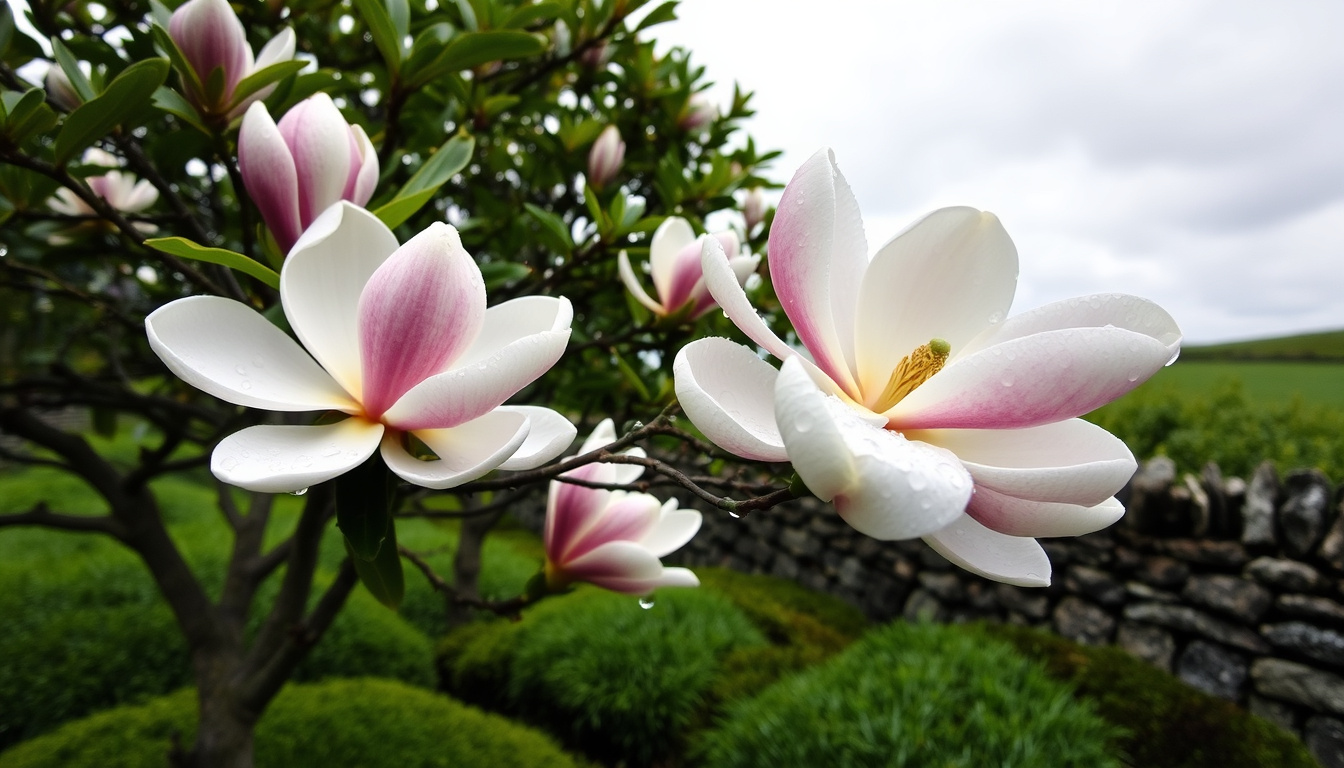
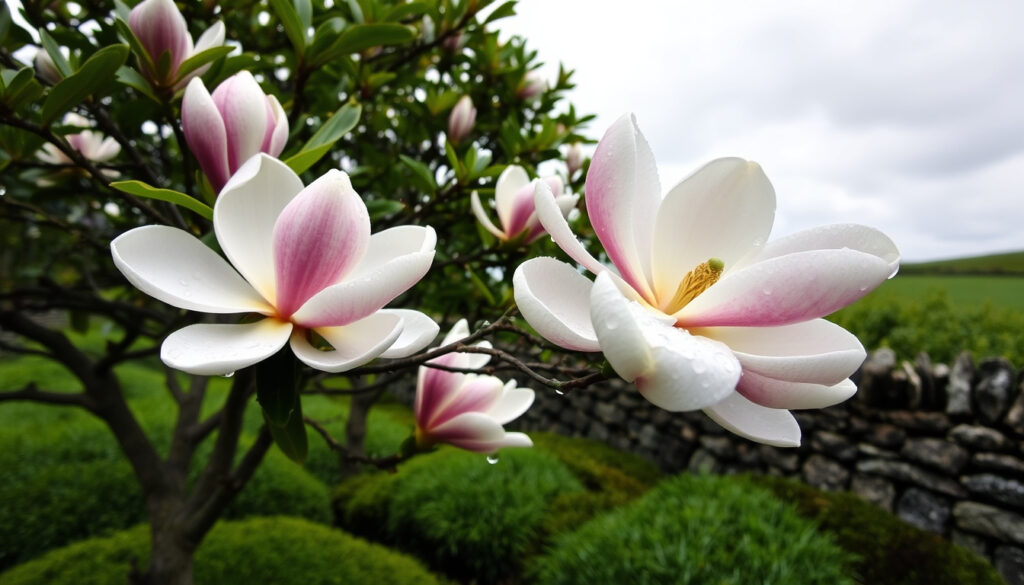
Few garden trees reward patience quite like a magnolia. If you’ve been dreaming of those big, waxy blooms in your own Irish garden, the good news is that magnolias can thrive here — provided you choose the right spot and the right variety.
Native range: East Asia and Americas ·
Species count: Over 200 ·
First bloom age (seed-grown): 10–15 years ·
Typical mature height in Ireland: 4–15 m depending on variety ·
Preferred soil pH: 5.5–6.5 (slightly acidic) ·
Best planting time in Ireland: Spring or autumn
Quick snapshot
- Irish maritime climate is suitable for many magnolia species
- Frost tender varieties need sheltered spots
- Evergreen magnolia thrives in west and southwest Ireland
- Full sun to partial shade required
- Shelter from strong winds
- Slightly acidic, well-drained soil
- Grafted: 2–5 years
- Seed-grown: 10–15 years
- Peak bloom: April to June depending on variety
- Late frosts kill flower buds
- Alkaline soil causes yellowing leaves
- Deciduous varieties drop leaves in autumn
The key facts below give a quick reference for the most important magnolia characteristics.
| Specification | Value |
|---|---|
| Botanical name | Magnolia spp. |
| Native to | East Asia, North America, Central America |
| Flower colour range | White, pink, purple, yellow, cream |
| Foliage type | Deciduous or evergreen (evergreen: Magnolia grandiflora) |
| Hardiness in Ireland | Generally hardy; some species need winter protection |
| Typical height range | 1.5 m (dwarf) to 15 m (tree forms) |
Can magnolia grow in Ireland?
Irish climate suitability for magnolias
Yes, magnolias grow well in Ireland’s temperate maritime climate. The mix of mild winters, moderate rainfall and relatively cool summers suits the majority of magnolia species. The key is matching the right variety to your particular microclimate. Frost-sensitive varieties need protection from late frosts, but most hardy types will establish without trouble.
- The Royal Horticultural Society (UK gardening authority) confirms that most magnolias prefer full sun, fertile moist well-drained soil, slightly acidic or neutral conditions, and a sheltered position — all achievable in Ireland.
- Ardcarne Garden Centre (Irish garden specialist) notes that evergreens such as Magnolia grandiflora are popular choices for Irish gardens and can thrive in sheltered coastal areas.
The implication: Irish gardeners in milder, coastal regions have more variety options, while those in exposed areas must prioritise hardy deciduous types.
Hardy magnolia varieties for Ireland
Several varieties are well suited to Irish conditions. Magnolia stellata, Magnolia x soulangeana and Magnolia grandiflora are among the most reliable. Dwarf forms such as Magnolia stellata ‘Royal Star’ stay under 2 m, ideal for small gardens. Clarenbridge Garden Centre (Irish plant retailer) lists a range of deciduous and evergreen varieties that perform well in Irish soil.
Irish gardeners who choose a variety matched to their region — for example, a frost-tender magnolia in a sheltered Cork garden versus a hardy stellata in a exposed Mayo plot — avoid the most common cause of magnolia failure: the wrong plant in the wrong place.
Where is the best place to plant a magnolia tree?
Soil requirements
Magnolias need fertile, free-draining, slightly acidic soil. Ardcarne Garden Centre (Irish garden specialists) advises that most magnolias prefer a soil pH between 5 and 6, and warns against very alkaline soils unless improved with organic matter. Good drainage is essential because waterlogged ground can stress young magnolias.
Sun and shelter considerations
Full sun or light dappled shade is best. Shelter from strong prevailing winds improves bud retention and the length of the floral display according to Ardcarne’s guide. A south- or west-facing position near a wall, hedge or mature shrubs provides the protection magnolias need.
Spacing and companion plants
Allow enough space for the mature spread — up to 8 m for larger varieties. Magnolias have shallow, fleshy roots that resent disturbance, so avoid planting near annual beds where digging is frequent. Gardenista (landscaping resource) notes that magnolias do well paired with spring bulbs, ferns and shade-tolerant perennials such as hostas, which complement their root system.
Step-by-step planting guide
- Dig a planting hole at least twice the width of the rootball and incorporate plenty of compost or well-rotted organic matter (Ardcarne Garden Centre).
- Plant at the same depth as the pot — magnolias dislike being planted too deeply.
- Water thoroughly after planting and keep well watered during dry spells while the tree establishes.
- Mulch with bark or leaf mould to retain moisture and protect the shallow roots.
The pattern: careful soil preparation, correct planting depth, and consistent moisture in the early years give magnolias the best start in Irish gardens.
How many years does it take for a magnolia to bloom?
Bloom age by propagation method
The time to first bloom depends heavily on how the magnolia was grown. Ardcarne Garden Centre states that seed-grown magnolias can take 10–15 years before they produce their first flowers. Grafted or layered plants bloom much sooner, typically within 2–5 years. Container-grown specimens often flower earlier still because they have been nurtured in optimal conditions.
Factors influencing first bloom
Sunlight, soil health and root establishment all play a role. A RHS growing guide emphasises that insufficient sunlight (less than 6 hours a day) can delay flowering by several years. Similarly, soil that is too alkaline or compacted will slow the maturation process.
Impatient gardeners who buy a seed-grown bargain may wait a decade for blooms. Paying more for a grafted or pot-grown magnolia from a reputable Irish nursery — such as those listed by Future Forests (Irish native tree supplier) — gives you flowers in a fraction of the time.
Why is my magnolia tree not blooming?
Sunlight and temperature issues
The most common cause is insufficient sunlight. RHS advises that magnolias need at least 6 hours of direct sun per day to form flower buds. Late frost is another major culprit — early-flowering varieties can lose their buds if a cold snap arrives after the buds have swelled. Ardcarne Garden Centre suggests temporary fleece protection for young trees if severe frost is forecast during bud formation.
Soil and nutrient problems
Soil pH that is too alkaline reduces flowering. Magnolias prefer slightly acidic conditions (pH 5.5–6.5). A soil test kit can confirm this. Over-fertilising with high-nitrogen feed encourages leafy growth at the expense of flowers. Switch to a balanced slow-release fertiliser or an ericaceous feed if the soil is more neutral, as per Ardcarne’s feeding advice.
Pruning mistakes
Magnolias require minimal pruning. RHS warns that heavy pruning removes the flower buds for the following season. If pruning is needed, do it lightly in mid to late summer after flowering has finished to avoid sap bleeding.
The most overlooked factor in Irish gardens is late frost. A warm March followed by an April frost can kill every bud on a Magnolia stellata. Gardeners in frost-prone areas should choose later-flowering varieties or plant near a south-facing wall that radiates heat.
What are the cons of having a magnolia tree?
Upsides
- Spectacular spring display and fragrant flowers
- Long-lived tree that becomes a garden centrepiece
- Low disease and pest issues in Irish conditions
- Evergreen varieties provide year-round structure
Downsides
- Slow growth to maturity
- Large deciduous varieties drop leaves and seed pods in autumn
- Frost damage risk for early-flowering types
- Shallow, fleshy roots can be sensitive to disturbance and may spread on the surface
Ardcarne Garden Centre highlights that magnolias have shallow roots that resent disturbance, so planting near lawns or areas of heavy foot traffic is not ideal. The RHS also notes that some deciduous varieties can be messy in autumn, dropping large leaves and fleshy seed pods that need clearing.
The catch: magnolias trade slow growth and sensitivity for a spectacular bloom. Gardeners who can provide the right conditions accept these trade-offs willingly.
Specifications of popular magnolia varieties for Ireland
Six common varieties share one pattern: a trade-off between size, bloom time and hardiness.
| Variety | Type | Mature height (Ireland) | Flower colour | Bloom time | Hardiness |
|---|---|---|---|---|---|
| Magnolia grandiflora | Evergreen | 10–15 m | White, fragrant | June–September | Hardy in mild coastal areas |
| Magnolia stellata | Deciduous | 2–4 m | White, star-shaped | March–April | Hardy in most Irish gardens |
| Magnolia x soulangeana | Deciduous | 4–8 m | Pink-purple with white | April–May | Hardy but frost-sensitive flowers |
| Magnolia liliiflora | Deciduous | 2–3 m | Deep purple-red | April–May | Needs sheltered spot |
| Magnolia wilsonii | Deciduous | 3–5 m | White with red stamens | May–June | Hardy, good for woodland gardens |
| Magnolia ‘Yellow Bird’ | Deciduous | 5–8 m | Yellow | May–June | Hardy, flowers later to avoid frost |
The pattern: later-flowering varieties in the table (e.g., ‘Yellow Bird’, grandiflora) offer more reliable bloom in frost-prone parts of Ireland. Gardeners in colder counties like Donegal or Monaghan should lean toward these over early-blooming stellata types.
Confirmed facts and what’s still unclear
Confirmed facts
- Magnolia trees can grow in Ireland (Ardcarne Garden Centre).
- Evergreen magnolia (Magnolia grandiflora) is widely available in Ireland (Clarenbridge Garden Centre).
- First bloom from seed takes 10–15 years (Ardcarne Garden Centre).
- Best planting time is spring or autumn (Ardcarne Garden Centre).
- Soil should be slightly acidic and well-drained (Royal Horticultural Society).
What’s unclear
- Exact bloom date varies by microclimate and variety in Ireland — no centralised phenology data is available.
- Optimal companion plants for magnolias in Irish gardens are not universally documented.
- Long-term survival of frost-tender magnolia cultivars in northern Ireland is uncertain due to limited trials.
“Magnolias require very little pruning; if pruning is needed, do it lightly in mid to late summer after flowering to avoid sap bleeding.”
Ardcarne Garden Centre (Irish garden specialists)
“Most magnolias prefer full sun, fertile moist well-drained soil, slightly acidic or neutral conditions, and a sheltered position.”
Royal Horticultural Society (UK horticultural authority)
“For best results plant magnolias in a sheltered position protected from strong prevailing winds, ideally south or west facing near a wall, hedge, or mature shrubs.”
Ardcarne Garden Centre (Irish garden specialists)
The decision to plant a magnolia in Ireland comes down to patience and placement. If you have a sheltered, sunny spot with acidic soil and the patience to wait 2–5 years for grafted blooms, the reward is spectacular. For gardeners in exposed or alkaline ground, the trade-off is clear: choose a hardy, later-flowering variety or improve your soil first. Either way, the magnolia’s slow growth and sensitivity mean it’s not a tree for instant gratification — but for those who plan ahead, it becomes the anchor of the garden.
savatree.com, monrovia.com, youtube.com, arbormasters.com, plants.sc.egov.usda.gov, gardenia.net
Frequently asked questions
Can magnolia trees grow in pots in Ireland?
Yes, but choose dwarf varieties such as Magnolia stellata or Magnolia ‘Little Gem’. Use a large container with ericaceous compost and ensure good drainage. Potted magnolias need more frequent watering and mulching to protect roots from frost.
Do magnolias need ericaceous compost?
If your soil is neutral or alkaline, yes. Magnolias prefer slightly acidic conditions (pH 5–6). Ericaceous compost lowers pH and provides the right nutrient balance. In naturally acidic Irish soil, it may not be necessary.
How often should I water a newly planted magnolia?
Water deeply once or twice a week during dry spells for the first two years. Consistent moisture is essential — magnolias dislike drying out out, but they also cannot tolerate waterlogged ground. (Ardcarne Garden Centre)
What is the best fertiliser for magnolias?
A balanced slow-release fertiliser (e.g., 10-10-10) applied in early spring works well. For more neutral soils, use an ericaceous feed. Avoid high-nitrogen feeds that encourage leaf growth at the expense of flowers.
Are magnolia roots invasive?
No. Magnolia roots are fleshy, shallow and spread wide near the surface, but they are not aggressive and rarely damage foundations. However, they resent disturbance, so avoid digging or planting directly over the root zone.
When should I prune a magnolia tree in Ireland?
Immediately after flowering in mid to late summer. Pruning in winter or early spring causes sap bleeding and removes next year’s flower buds. Keep pruning light. (Ardcarne Garden Centre)
Can I grow a magnolia from a cutting?
Yes, but it is slow and success rates are moderate. Semi-ripe cuttings taken in late summer with rooting hormone and bottom heat have the best chance. Grafted or layered plants are far more reliable for home gardeners. (RHS)
For Irish gardeners, the choice is clear: select a variety matched to your microclimate and soil, plant it with care, and give it time. The magnolia will repay your patience with one of the most breathtaking spring displays a garden can offer.

Rachel Bennett leads fact-checking, source verification and corrections at Coast Pulse.