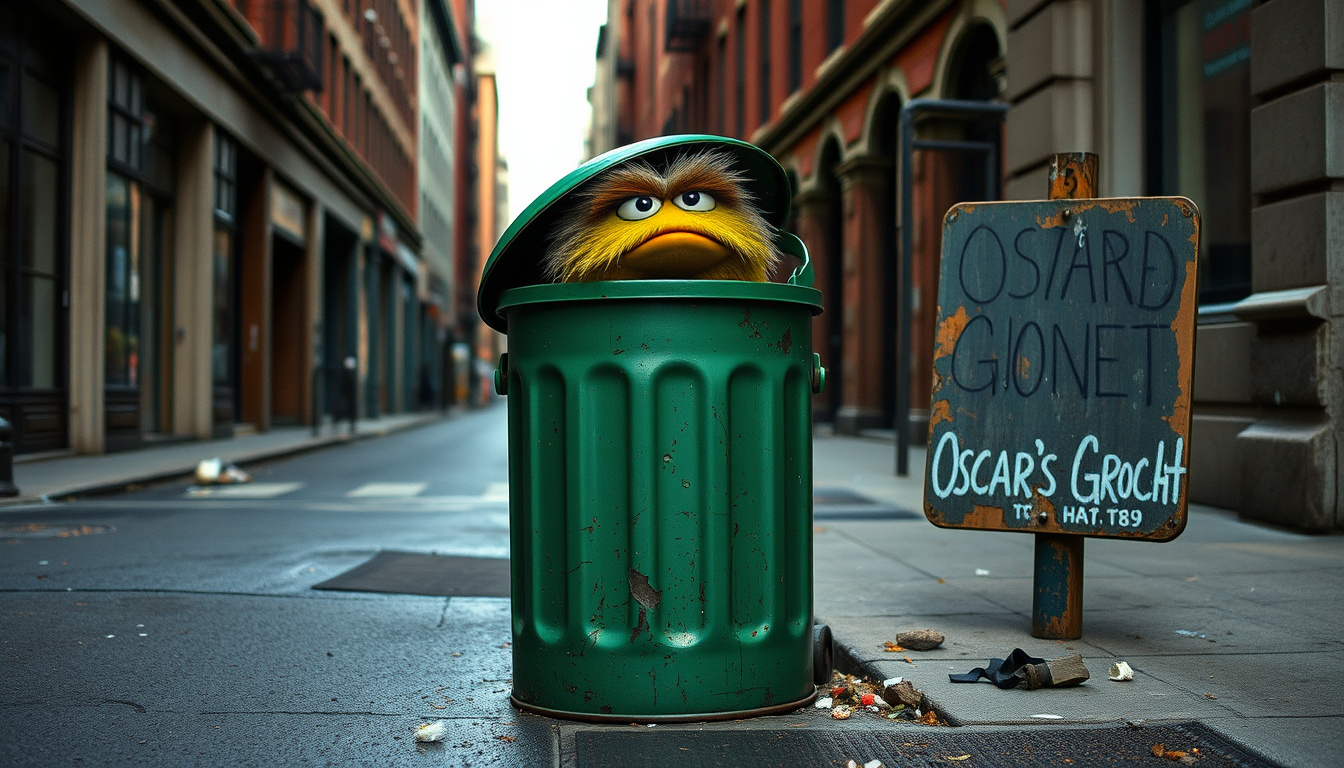
There’s something oddly comforting about a character who openly admits he’d rather be left alone — and means it. Oscar the Grouch has been scowling, hoarding trash, and telling cheerful Sesame Street residents to get lost since his debut in 1969, according to Sesame Workshop (official character profile), yet he remains one of the most beloved Muppets ever created.
First appearance: 1969 ·
Original color: Orange ·
Color change year: 1970 ·
Original performer: Caroll Spinney ·
Current performer: Eric Jacobson ·
Catchphrase summary: I love trash
Quick snapshot
- Green Muppet who lives in a trash can (Sesame Workshop)
- Grouchy by nature — despises “nice” things (Sesame Workshop)
- Created by Jim Henson and Jon Stone (Wikipedia)
- “I Love Trash” — his signature song (Sesame Workshop)
- “Go away!” — classic dismissal (Muppet Wiki)
- “That’s perfect” — said about messes (Muppet Wiki)
- Slimey the Worm — his pet (Sesame Workshop)
- Educational tool for teaching about emotions (Smithsonian Institution)
- Enduring icon of children’s television (Smithsonian Institution)
- Model for tolerance and diversity (Smithsonian Institution)
Six key facts about the Muppet who turned contrarianism into an art form.
| Attribute | Value |
|---|---|
| Original color | Orange (Smithsonian Institution) |
| Current color | Green (Smithsonian Institution) |
| Birth year | 1969 (Sesame Workshop) |
| Original performer | Caroll Spinney (Wikipedia) |
| Current performer (since 2003) | Eric Jacobson (Wikipedia) |
| Residence | Trash can on Sesame Street |
Why is Oscar the Grouch so grouchy?
Personality roots
- Oscar’s grouchiness is a core character trait that brings him joy — he genuinely enjoys being miserable (Sesame Workshop (official character description))
- His personality was designed to teach children that it’s okay to have different moods and emotions (Smithsonian Institution (museum artifact record))
- He despises “nice” things like rainbows, candy, and chocolate
Oscar doesn’t see grouchiness as a flaw — he sees it as a lifestyle. According to Muppet Wiki (fan-curated database), his mission in life is to be as miserable and grouchy as possible and to spread that feeling to others. The twist: it makes him genuinely happy.
Character design philosophy
- The character was created to demonstrate that negative emotions are normal and manageable
- Oscar models tolerance by being a grouch who still cares about his friends (Smithsonian Institution)
- His design — green fur, bushy eyebrows, trash can — makes him visually distinct from the more colorful, upbeat Muppets
Sesame Workshop has said that Oscar enjoys loud noises, collecting junk, arguing, rainy days, and other annoyances that would bother most people. He is, in his own way, the happiest grouch on television.
Grouchiness as happiness
- Being grouchy makes Oscar happy — it’s not a burden, it’s his personality (Sesame Workshop)
- The show uses Oscar to indirectly teach children that difference is normal and valuable
- Oscar has a softer side: he is a caring friend to Slimey, Fluffy, and Spot (Sesame Workshop)
The most beloved grouch on television proves that the key to happiness might be accepting who you are — even if who you are is someone who hates everything.
This paradox makes Oscar a memorable character for both children and adults.
What is Oscar the Grouch famous for saying?
I Love Trash lyrics
- Oscar’s most famous song is “I Love Trash,” written by Joe Raposo
- The song celebrates his love for garbage, junk, and discarded items
- It has been performed in multiple episodes and albums since the early 1970s
“I Love Trash” is Oscar’s anthem. The song’s opening lines — “Oh, I love trash, anything dirty or dingy or dusty, anything ragged or rotten or rusty” — perfectly encapsulate his worldview. According to Sesame Workshop (official Sesame Street character page), the song remains one of the most recognizable Muppet musical moments ever recorded.
Signature catchphrases
- “Go away!” — his most frequent dismissal
- “That’s perfect” — said approvingly about messes and chaos
- “I love trash” — also commonly used as a spoken line
Oscar’s catchphrases all share one thing in common: they celebrate the opposite of what most people want. Where other characters say “hello,” Oscar says “go away.” Where others seek neatness, Oscar praises disaster. According to Muppet Wiki (fan encyclopedia), his dialogue is built around rejoicing in annoyance and finding joy in negativity.
Common grouchy remarks
- “I hate nice” — a recurring theme
- “Scram!” — another form of dismissal
- Various complaints about rainbows, sunshine, and candy
Why did they change Oscar the Grouch to green?
Original color was orange
- Oscar first appeared in 1969 as an orange Muppet (Smithsonian Institution (museum collection record))
- The orange puppet appeared only during the first season
- Early concept drawings actually show an even earlier version: a spiky, grumpy-looking magenta monster (Smithsonian Institution)
The orange Oscar is a piece of Sesame Street trivia that still surprises longtime fans. The Smithsonian Institution (national museum collection) holds one of the original orange Oscar puppets, documenting the transition.
The 1970 color change
- The change to green happened for the second season in 1970 (Smithsonian Institution)
- In-universe, Oscar explained that he had vacationed at Swamp Mushy Muddy, where the dampness turned him green overnight (Muppet Wiki)
- He later claimed in a 2003 appearance that he was actually orange underneath the slime and mold (Muppet Wiki)
The in-show explanation — a swamp vacation turning him green — is classic Oscar: instead of a straightforward reason, viewers got a story that reinforced his messy, unpredictable personality.
Technical and creative reasons
- Early color-television limitations contributed to the decision to move from orange to a more distinct green (Smithsonian Institution)
- The orange fur may have been harder to work with under studio lights
- Green gave Oscar a more distinctive, memorable silhouette that stood out among other Muppets
The orange-to-green transition shows that even beloved characters are products of practical production decisions — and that good storytelling can turn a technical constraint into a cherished piece of lore.
The continuity of Oscar’s character remains unbroken despite the color shift.
What is Oscar the Grouch’s worm called?
Slimey the Worm
- Oscar’s pet worm is named Slimey (Sesame Workshop)
- Slimey is a small, pink worm who lives in Oscar’s trash can
- The character has appeared in multiple episodes and specials
Slimey is one of the few creatures Oscar genuinely cares about. According to Sesame Workshop (official character profile), Oscar’s relationship with Slimey reveals his softer side — he may hate people, but he loves his pets.
Relationship with Oscar
- Oscar is protective and nurturing toward Slimey
- Slimey is often used in storylines about friendship and responsibility
- Oscar also cares for Fluffy the Elephant (a pet) and Spot (a dog)
Worm as pet
- Slimey fits Oscar’s aesthetic: a pet that lives in dirt and garbage
- The worm character reinforces Oscar’s love for things others find unpleasant
- Slimey has his own adventures, including a famous trip to the moon
What things are associated with Oscar the Grouch?
Trash can home
- Oscar lives in a trash can on Sesame Street (Sesame Workshop)
- His home is filled with discarded objects, junk, and recyclable materials (Sesame Workshop)
- The trash can has become one of the most recognizable fictional residences in television
Rubbish and trash
- Oscar loves trash, dirt, and mess of all kinds
- He collects junk that others have thrown away
- His trash can doubles as a showcase for recycling and reusing items
Dislikes
- Oscar hates rainbows, candy, chocolate, and anything “nice”
- He dislikes sunshine, happiness, and cheerful greetings
- He opposes the general upbeat tone of Sesame Street
Grouch culture
- Grouch culture on Sesame Street is about embracing imperfection and mess
- Other Grouch characters appear occasionally, reinforcing the theme
- Oscar is the flagship Grouch — the one who defines what it means to be grouchy
Which Muppet has autism?
Julia the Muppet
- Julia is a Muppet character with autism, introduced in 2015
- She is part of Sesame Street’s autism outreach initiative, Sesame Street and Autism: See Amazing in All Children
- Julia has red hair, green eyes, and a friendly but reserved demeanor
Julia was created to help normalize autism for young audiences. According to Wikipedia (Sesame Street character encyclopedia entry), her introduction was carefully developed with input from autism advocacy groups, psychologists, and families.
Autism representation on Sesame Street
- Julia’s autism is portrayed through behaviors like hand-flapping, repeating phrases, and needing extra time to process social cues
- The show uses Julia to teach neurotypical children about autism
- Episodes featuring Julia focus on patience, understanding, and friendship
Educational impact
- Julia’s character has been praised by autism advocacy organizations for accurate, respectful representation
- The initiative includes digital resources for families and educators
- Julia appears in episodes, books, and online content
Is there any LGBTQ representation on Sesame Street?
LGBTQ Muppet characters
- Sesame Street has included LGBTQ themes and characters in recent years
- There are Muppet characters with two dads, reflecting modern family structures
- The show has also featured same-sex couples in background and foreground roles
Sesame Workshop has gradually expanded the representation of different family types on the show. According to Wikipedia (Sesame Street series overview), the show has always aimed to reflect the diversity of its audience, including family composition.
History of inclusion
- Sesame Street has a long history of addressing social issues through its content
- The show has featured diverse cast members and storylines since its debut
- LGBTQ inclusion is part of a broader commitment to representing all families
Current representation
- The current season includes families with same-sex parents
- Sesame Workshop has published resources on family diversity
- The approach has been praised by LGBTQ advocacy groups
Timeline
Oscar the Grouch first appears on Sesame Street as an orange Muppet (Smithsonian Institution)
Oscar’s color changes from orange to green for technical and creative reasons (Smithsonian Institution)
Eric Jacobson takes over as primary performer after Caroll Spinney’s retirement (Wikipedia)
Julia, a Muppet with autism, is introduced, expanding Sesame Street’s inclusive reach
Confirmed facts
- Oscar debuted in 1969 (Sesame Workshop)
- Original color was orange (Smithsonian Institution)
- Changed to green in 1970 (Smithsonian Institution)
- Catchphrase “I Love Trash” (Sesame Workshop)
- Pet worm is Slimey (Sesame Workshop)
- Caroll Spinney was original performer (Wikipedia)
What’s unclear
- Exact reason for color change — technical limitations or creative choice? (Smithsonian Institution)
- Was Oscar originally imagined as a magenta monster before orange? (Smithsonian Institution)
- Did a rude waiter inspire the character? (Muppet Wiki)
- Was Oscar’s voice based on a New York taxi driver? (Smithsonian Institution)
- Full extent of Eric Jacobson’s performance history as primary voice (Wikipedia)
- Is Oscar still orange underneath the slime? (Muppet Wiki)
- Other Sesame Street Muppets he complains to
- Part of broader Grouch culture on the show
“Jim Henson based Oscar’s voice on a cranky New York taxi driver, according to Caroll Spinney.”
— Smithsonian Institution (Muppet artifact documentation)
“Oscar the Grouch is the resident Grouch who despises things considered ‘nice’ and says that being grouchy makes him happy.”
— Sesame Workshop (official character summary)
For Sesame Street, Oscar the Grouch is more than a Muppet — he is a deliberate lesson in emotional diversity wrapped in green fur and buried in trash. The character’s enduring appeal lies in his refusal to conform: he is happy being unhappy, and that paradox has resonated with audiences for over five decades. For parents and educators looking to teach children that all feelings are valid, Oscar remains the most honest teacher on the block. For everyone else, he is proof that being a little grouchy now and then is not just okay — it might be exactly the right response.
toughpigs.com, facebook.com, facebook.com, sesamestreet.whro.org
For a broader look at the show’s cast, including other beloved Sesame Street characters, readers can explore the full roster of main Muppets and their histories.
Frequently asked questions
What is the catchphrase of Oscar the Grouch?
“I Love Trash” is his most famous catchphrase, also the title of his signature song. He also frequently says “Go away!” and “That’s perfect” about messes.
Who originally performed Oscar the Grouch?
Caroll Spinney was the original performer, voicing Oscar from 1969 until his retirement. Eric Jacobson took over as primary performer in the 2000s.
How did Oscar the Grouch get his name?
The name “Oscar” reportedly came from a rude waiter at Oscar’s Tavern in Manhattan, according to Muppet lore. The “Grouch” part describes his defining personality trait.
What was Oscar the Grouch’s original color?
Oscar was originally orange when he first appeared in 1969. He changed to green for the second season in 1970.
Does Oscar the Grouch have a pet?
Yes — his pet is Slimey the Worm, who lives in Oscar’s trash can. Oscar also has other pets named Fluffy and Spot.
Is Oscar the Grouch still on Sesame Street?
Yes, Oscar remains a regular character on Sesame Street, performed by Eric Jacobson. He continues to live in his trash can and spread grouchy cheer.
What is the theme song of Oscar the Grouch?
Oscar’s theme song is “I Love Trash,” written by Joe Raposo. The song celebrates his love for garbage and discarded items.

Ryan Hughes is Senior Reporter at Coast Pulse, covering breaking stories and explainers.