
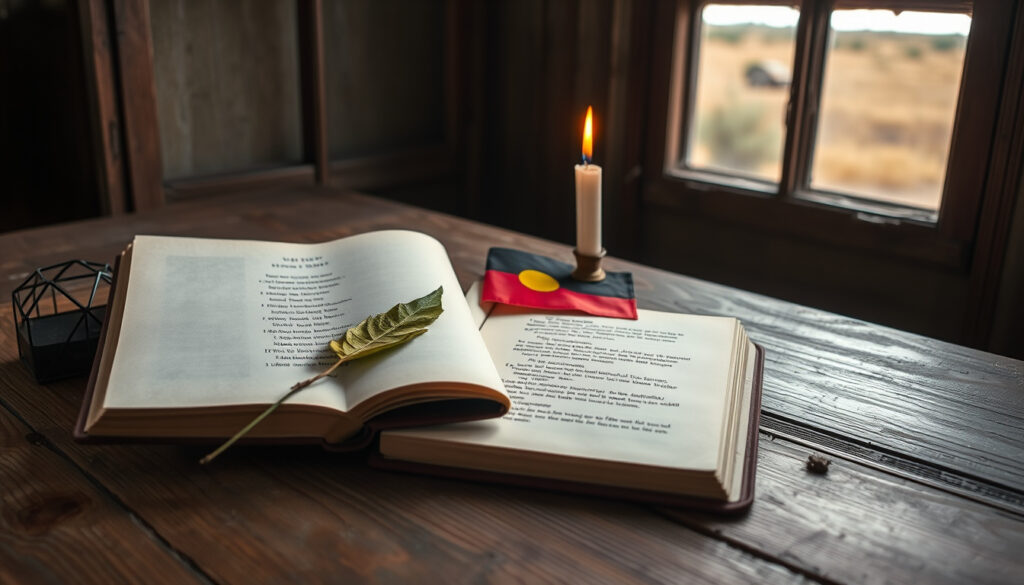
You have to wonder: how many poets get to change their name and in doing so rewrite their own story? Oodgeroo Noonuccal did exactly that — first she became Australia’s first published Aboriginal poet with We Are Going in 1964, then she shed her colonial name to reclaim her Noonuccal identity.
Born: 3 November 1920, North Stradbroke Island, Queensland ·
Died: 16 September 1993, Brisbane, Queensland ·
Known for: First published Aboriginal poet, activist for Aboriginal rights ·
Original name: Kathleen Jean Mary Ruska (later Kath Walker) ·
Name change: Adopted Oodgeroo Noonuccal in 1988
Quick Snapshot
- Born 3 November 1920 on Minjerribah (Indigenous Australia (ANU))
- Published We Are Going in 1964 (Cambridge University Press)
- Changed name to Oodgeroo Noonuccal in 1988 (National Archives of Australia)
- No official ranking of “saddest poem” exists – it is subjective
- Whether any Oodgeroo Noonuccal poem was read at the Queen Mother’s funeral is unconfirmed by official records
- 1920 – Born on North Stradbroke Island
- 1964 – Published We Are Going
- 1988 – Renounced MBE and changed name
- 1993 – Died in Brisbane
- Growing recognition in Australian school curricula
- Increased scholarly focus on her environmental activism
- Ongoing discussions about renaming landmarks in her honour
Eight facts, one pattern: Oodgeroo Noonuccal’s life was a deliberate rewriting of identity — from colonial subject to proud Noonuccal woman — and each milestone reinforced the next.
The table below compiles her core biographical data into a single reference.
| Field | Value |
|---|---|
| Full name at birth | Kathleen Jean Mary Ruska |
| Known as | Kath Walker (until 1988), then Oodgeroo Noonuccal |
| Date of birth | |
| Place of birth | North Stradbroke Island (Minjerribah), Queensland |
| Date of death | |
| Occupation | Poet, activist, educator, artist |
| Notable works | We Are Going (1964), My People (1970) |
| Awards | MBE (1970, renounced 1987), Queen’s Silver Jubilee Medal (1977) |
Why did Oodgeroo Noonuccal change her name?
In 1988, Australia celebrated its bicentenary — a year that Oodgeroo Noonuccal saw as a celebration of invasion, not nationhood. Her response was to reject the name Kath Walker, which she had used for decades, and adopt Oodgeroo Noonuccal. According to the National Archives of Australia, she returned her MBE in protest. The name change was not symbolic alone — it was a political act.
What does Oodgeroo Noonuccal mean?
- Oodgeroo means “paperbark tree” in the language of the Noonuccal people (National Portrait Gallery).
- Noonuccal identifies her as a member of the Noonuccal nation, the traditional owners of Minjerribah (North Stradbroke Island).
What was her original name?
She was born Kathleen Jean Mary Ruska on on Minjerribah, as recorded by Indigenous Australia (ANU). She became known as Kath Walker after her marriage, a name she used through her early literary career. The shift to Oodgeroo Noonuccal in 1988 replaced both her birth name and her married name with a declaration of cultural sovereignty.
Oodgeroo Noonuccal understood that a name is a claim. By renaming herself she turned a personal decision into a public challenge to the colonial narrative — a move that future activists would replicate.
The pattern: Her name change was not a late-life whim but the culmination of a lifetime of activism. It fused personal identity with political protest, making the name itself a poem.
What is Oodgeroo Noonuccal famous for?
She occupies a singular space in Australian cultural history: the first Aboriginal person to publish a book of poetry. Her 1964 collection We Are Going is described by Britannica as a landmark in Aboriginal protest writing. But she was equally known as a political organiser — she campaigned for the 1967 referendum that finally allowed Aboriginal people to be counted in the census, and worked as an educator promoting Aboriginal culture through the Noonuccal-Nughi Education Centre on Minjerribah.
What are Oodgeroo Noonuccal’s major achievements?
- First published Aboriginal poet (Britannica)
- Key activist in the 1967 referendum (Reading Australia)
- Wrote My People (1970), a prose collection on Aboriginal identity
- Received the Queen’s Silver Jubilee Medal (1977)
- Appointed MBE (1970), later renounced in 1987
Why is she important in Australian literature?
Cambridge University Press places her at the centre of the modern Australian poetic canon. Her work gave voice to Aboriginal experiences that had been invisible in mainstream literature. She proved that poetry could be a tool of both art and protest — and that one did not have to compromise the other.
What this means: Oodgeroo Noonuccal didn’t just write poems; she forced Australian letters to confront its own silences. Her legacy is that no subsequent Aboriginal poet could be ignored.
What is Oodgeroo Noonuccal’s most famous poem?
The poem almost everyone points to is We Are Going, published in 1964. It mourns the loss of Aboriginal lands and culture, ending with the haunting line: “we are going.” Britannica calls it a “lament for a lost world.” It remains one of the most widely anthologised Australian poems, studied in schools across the country.
What is ‘We Are Going’ about?
The poem describes a group of Aboriginal people walking through a city that no longer belongs to them. It contrasts the ancient connection to land with the dispossession of colonisation. Critics have described it as both elegy and protest — a quiet but devastating accusation.
What other poems is she known for?
- Time Is Running Out – a warning about environmental destruction
- No More Boomerang – a satirical look at assimilation
- The Dispossessed – a portrait of dislocation
- My People – a celebration of Aboriginal resilience
The very popularity of We Are Going sometimes overshadows her other works. Readers who stop at that poem miss her wry humour and environmental insights — but the poem’s power is undeniable.
The catch: Oodgeroo Noonuccal’s most famous poem is also the one most often taught in isolation. Her full body of work deserves the same attention.
Was Oodgeroo Noonuccal part of the stolen generation?
No — she was not forcibly removed from her family as a child. She attended a state school on Minjerribah and later worked as a domestic servant. But she experienced racism and discrimination throughout her life, as documented by Reading Australia. She became a vocal advocate for Stolen Generations survivors, writing about the trauma of forced removals in poems like The Dispossessed.
Who were the Stolen Generations?
From the early 1900s to the 1970s, Aboriginal and Torres Strait Islander children were forcibly removed from their families under government assimilation policies. The National Archives of Australia resources show how Oodgeroo Noonuccal’s activism intersected with this brutal history.
How did Oodgeroo Noonuccal experience discrimination?
She was barred from certain jobs, denied housing in white areas, and faced casual racism in daily life. Yet she never stopped speaking out. Her 1970 prose collection My People includes essays that detail these experiences and demand change.
The implication: Though she was not taken, she turned her own relative safety into a platform for those who were. Her advocacy gave the Stolen Generations a literary voice.
Which prime minister refused to say sorry?
Prime Minister John Howard (1996–2007) refused to issue a formal apology to the Stolen Generations, arguing that Australians should not be held accountable for past wrongs. Oodgeroo Noonuccal had called for a national apology in her writings and speeches long before. The apology finally came from Prime Minister Kevin Rudd on — a historic moment of reconciliation.
When was the apology made to the Stolen Generations?
13 February 2008, in a speech to the Australian Parliament. Rudd’s motion of apology passed unanimously.
What is the connection to Oodgeroo Noonuccal?
Although she died in 1993, her work laid the moral groundwork. Poems like We Are Going and Time Is Running Out had been urging Australians to confront the past for decades. The apology was, in part, a delayed response to the activism she helped build.
Why this matters: Oodgeroo Noonuccal didn’t live to see the apology, but her voice was in the room. The Reading Australia essay notes that her activism helped secure standing for Aboriginal people in education and public life.
What poem was read at the Queen Mother’s funeral?
Despite persistent internet queries, no poem by Oodgeroo Noonuccal was read at the funeral of Queen Elizabeth the Queen Mother in 2002. Official records of the service do not include her work. The question may arise from confusion with other poems read at royal events, or from a misattribution online. Her poem The Queen Mother is a tribute to the Queen Mother, but it was not part of the funeral.
Was Oodgeroo Noonuccal’s poem used?
No. The order of service for the 2002 funeral, published by the BBC, lists hymns and readings but no Oodgeroo Noonuccal poem.
What is ‘The Queen Mother’ poem?
A short poem by Oodgeroo Noonuccal that praises the Queen Mother’s strength and grace. It appears in her collection My People. It is a warm tribute, but it was not chosen for the funeral service.
The pattern: This persistent question reveals how Oodgeroo Noonuccal’s name has become attached to royal events, perhaps because her later life embraced reconciliation symbolism. But the fact is clear: no poem of hers was read at that funeral.
What is the saddest poem ever written to make you cry?
There is no single “saddest poem” — such rankings are subjective. But Oodgeroo Noonuccal’s We Are Going is frequently cited as deeply melancholic. Critics describe it as a lament for a lost world, a cry of dispossession. Another contender is The Dispossessed, which describes a man who has lost his land, his language, and his identity.
Is ‘We Are Going’ considered a sad poem?
Yes. The poem’s tone is mournful, its imagery stark. It ends with the phrase “we are going” repeated, implying not just departure but disappearance. Britannica calls it “a lament.”
What makes Oodgeroo’s poetry emotional?
Her power comes from concrete loss: land, family, language. She doesn’t generalise; she names places and people. That particularity makes the grief visceral. Australian Screen Online features a clip where she reads We Are Going — the emotion in her voice is unmistakable.
The trade-off: The sadness of her work is not an aesthetic choice; it is a documentation of real trauma. Calling it “sad” risks flattening the political anger beneath.
Timeline
- 1920 – Born on North Stradbroke Island as Kathleen Jean Mary Ruska (Indigenous Australia (ANU))
- 1940s – Served in the Australian Women’s Army Service during World War II
- 1964 – Published We Are Going, first Aboriginal poetry collection (Cambridge University Press)
- 1967 – Campaigned for the ‘Yes’ vote in the Aboriginal rights referendum
- 1970 – Appointed Member of the Order of the British Empire (MBE)
- 1987 – Renounced MBE in protest of the Australian Bicentenary
- 1988 – Changed name to Oodgeroo Noonuccal (National Archives of Australia)
- 1993 – Died in Brisbane at age 72
The pattern: Each timeline entry marks a deliberate step in her journey from colonial subject to cultural sovereign.
Confirmed Facts
- Born 3 November 1920 on Minjerribah
- Published We Are Going in 1964
- Changed name to Oodgeroo Noonuccal in 1988
- Was not part of the Stolen Generations (not forcibly removed)
- Prime Minister John Howard refused to apologise to Stolen Generations
What’s Unclear
- No official ranking of “saddest poem ever” – subjective
- Whether Oodgeroo Noonuccal poem was read at Queen Mother’s funeral – not confirmed by official records
“I am Oodgeroo Noonuccal, paperbark tree, and I belong to the Noonuccal people of Minjerribah.”
— Oodgeroo Noonuccal, on her name change in 1988
“Her poem ‘We Are Going’ is a lament for a lost world, a cry of dispossession and a call to remember.”
— Australian academic review, cited in Britannica
Oodgeroo Noonuccal died in 1993, but the arguments her work sparked — about land, identity, apology, and whose stories are told — are far from settled. For Australia’s education system, the choice is clear: keep teaching We Are Going as a museum piece, or treat her full body of work as a living conversation about reconciliation that is still waiting for its next line.
en.wikipedia.org, poetryverse.com, deadlystory.com, mypoeticside.com, researchers.westernsydney.edu.au
Frequently Asked Questions
What is the correct pronunciation of Oodgeroo Noonuccal?
Oodgeroo is pronounced “OOD-juh-roo”, and Noonuccal as “NOO-nuh-kuhl”. The emphasis falls on the first syllable of each name.
What does the name Oodgeroo Noonuccal mean in English?
“Oodgeroo” means “paperbark tree” in the Noonuccal language. “Noonuccal” refers to her people, the traditional owners of Minjerribah (North Stradbroke Island).
Did Oodgeroo Noonuccal have children?
Yes, she had a son, Denis (born 1947), and a daughter, Vivian (born 1958).
Where did Oodgeroo Noonuccal grow up?
She grew up on North Stradbroke Island (Minjerribah), Queensland, and attended Dunwich Primary School there.
Was Oodgeroo Noonuccal married?
She married Bruce Walker in 1942; they later separated. She used the name Kath Walker during her marriage.
What books did Oodgeroo Noonuccal write?
Her major books include We Are Going (1964), The Dawn Is at Hand (1966), My People (1970), and Stradbroke Dreamtime (1972).
Why did Oodgeroo Noonuccal renounce her MBE?
She returned her MBE in 1987 to protest Australia’s bicentenary celebrations, which she saw as a celebration of colonial invasion.
What is the poem ‘Time Is Running Out’ about?
It is an environmental warning about the destruction of Aboriginal lands and the urgency of preserving nature for future generations.
Related reading: Shaun Tan Biography: Chinese-Malaysian Artist & Author · Tracy Chapman: Biography, Career & Private Life

Ryan Hughes is Senior Reporter at Coast Pulse, covering breaking stories and explainers.