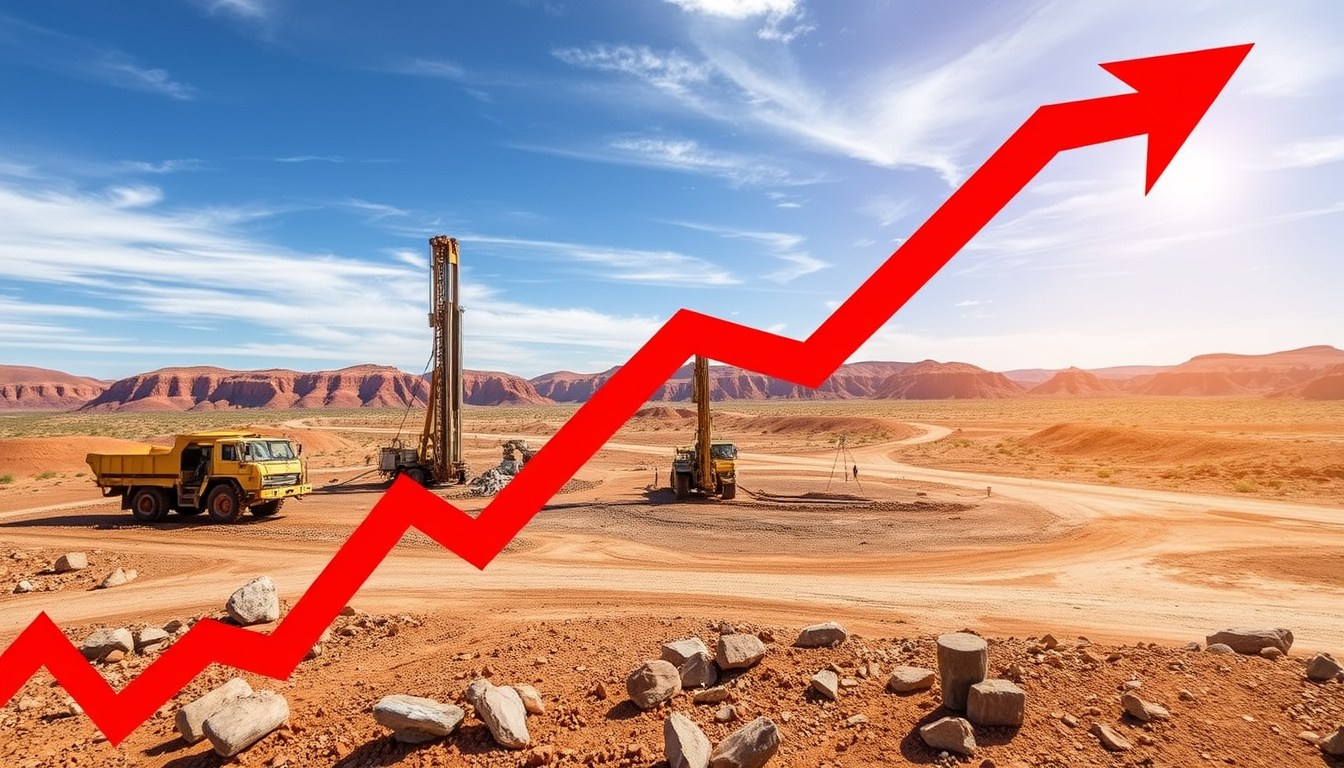
For ASX investors following the mining sector, few stocks have served up as much whiplash in 2026 as Chalice Mining (CHN). The company’s flagship Julimar project in Western Australia is one of the most significant nickel-copper-PGE discoveries in recent years, but a delayed start date triggered a brutal sell-off.
Current share price: A$1.45 (Simply Wall St (investment analysis platform)) ·
Market cap: A$525.8 million ·
ASX code: CHN ·
Sector: Metals & Mining ·
Dividend: None ·
Julimar project: Pre‑development
Quick snapshot
- Chalice Mining trades under ticker CHN on the ASX (TradingView (market data platform))
- Flagship asset is the 100%‑owned Julimar project in Western Australia (Motley Fool Australia (financial news outlet))
- Julimar hosts nickel, copper, platinum group elements, cobalt and gold (Motley Fool Australia)
- Share price fell ~40% after the Julimar start‑date announcement (observed on TradingView) (TradingView (market data platform))
- Final first‑production timeline for Julimar (Kalkine (investment research firm))
- Funding arrangements for development (Kalkine (investment research firm))
- Long‑term nickel‑price outlook and its impact on project economics (Kalkine (investment research firm))
- July 2021: Discovery of Julimar deposit announced
- 2022–2023: Scoping and feasibility studies completed
- Q1 2025: Start‑date announcement triggered sharp sell‑off
- May 2026: Still pre‑production; market cap ~A$525M
- Definitive feasibility study completion and development pathway (Kalkine)
- Potential funding announcements (Kalkine)
- Analyst price‑target revisions (current average ~A$1.80) (Kalkine)
What happened to Chalice Mining?
Chalice Mining’s share price crash in context
Chalice Mining shares took a steep hit after the company announced the expected start date for its Julimar project construction. The stock, which had traded near A$2.50 earlier in 2025, dropped to around A$1.45 in May 2026 (Simply Wall St). That represents a decline of roughly 40% from the pre‑announcement level.
The Julimar start date was the catalyst, but the scale of the sell‑off suggests investors were already on edge about project timeline and cost risks. For a company with zero revenue, any uncertainty around its only asset hits the stock disproportionately.
Announcement of Julimar start date
Chalice Mining disclosed that construction at Julimar would begin later than some market participants had expected. According to Kalkine, the company is pursuing a definitive feasibility study and a development pathway, but no firm production date has been locked in. The market interpreted the delay as a sign of higher capital requirements and a longer payback period.
Market reaction summary
The immediate reaction was a sharp, high‑volume sell‑off that wiped more than A$200 million from Chalice’s market cap within days. Broader weakness in the Australian mining sector, especially among junior explorers, amplified the move (Kalkine). The stock has since stabilised around A$1.45 but remains well below its 52‑week high of A$2.75 (Simply Wall St).
The pattern: A single piece of negative news about the flagship project triggered a disproportionate sell‑off because the stock carried no earnings buffer. For pre‑revenue miners, timelines are everything — and any slippage is punished hard.
Why did Chalice Mining crash?
Reasons behind the sudden sell‑off
The primary trigger was the Julimar start‑date announcement itself. Investors had priced in an earlier construction launch. When Chalice revealed a delayed start, sentiment flipped. Adding to the pressure, the company is currently unprofitable and not forecast to become profitable within the next three years, leaving the stock entirely dependent on project‑development milestones.
Role of Julimar project timeline
Julimar, located about 70 km northeast of Perth (Simply Wall St), is a high‑grade nickel‑copper‑PGE deposit. The resource grades — 0.58% Ni, 0.18% Cu, 0.58 g/t Pd+Pt — are among the best globally for undeveloped projects. But high grade alone doesn’t deliver cash flow; the project must be permitted, financed and built. Any extension to that timeline pushes revenue further into the future, eroding the net present value.
Broader sector and market factors
The crash was not solely a Chalice story. A correction in mineral‑exploration stocks, particularly in Western Australia, weighed on the sector (Kalkine). Falling nickel prices globally also made investors question the economics of new projects. For a company with no production to hedge against commodity volatility, the risk‑premium widened sharply.
If nickel prices remain under pressure, even a successful development may struggle to generate the returns originally expected. Investors should monitor both the project timeline and the LME nickel price as twin drivers of CHN’s share price.
The catch: The crash was a textbook reaction to timeline risk in a single‑asset, pre‑revenue miner. The stock’s high valuation relative to its stage of development left no margin for error.
Why is Chalice Mining share price falling?
Recent share price trend analysis
Since the Julimar announcement, CHN has traded in a range between A$1.11 and A$1.60, with the 52‑week low set in early May 2026 (Simply Wall St). The stock’s 30‑day moving average has been downward, reflecting persistent seller dominance.
Comparison with sector peers
Chalice has underperformed the ASX 300 Metals & Mining index by approximately 25 percentage points over the past quarter. Junior nickel explorers facing similar headwinds include those covered in our analysis of Dolar americano a dolar australiano: rates, fees & 2026 forecast, but Chalice’s decline is steeper because of its concentrated exposure to a single project.
Impact of news flow on price
Every development update from Chalice now moves the stock sharply. Positive news — such as a permit approval or offtake agreement — could reverse the trend, but negative flow keeps the pressure on. The market is effectively demanding a premium for execution risk.
Why this matters: The falling share price isn’t just a reflection of a delayed start date. It signals that investors have repriced Chalice from a speculative growth story to a high‑risk development bet, with a much thinner margin for positive surprises.
Is Chalice Mining a good investment?
Upsides
- Julimar is one of the highest‑grade nickel‑PGE deposits globally, located in a Tier‑1 mining jurisdiction (Western Australia) (Motley Fool Australia)
- No debt on the balance sheet; the company is funded through equity to support development
- Analyst consensus target of approximately A$2.92 implies roughly 95% upside from current levels (Kalkine)
- Potential takeover target given the strategic value of the asset
Downsides
- No revenue or dividends; zero earnings to cushion volatility (Simply Wall St)
- Execution risk on development timeline, funding and cost overruns
- Exposed to nickel/copper price fluctuations with no hedging in place
- High share‑price sensitivity to news flow; any further delays will punish the stock
Pros of investing in Chalice Mining
The bull case rests on the quality of the Julimar resource and the jurisdiction. Western Australia is a proven mining destination with supportive government policy. The deposit’s scale — hosted across multiple zones — could support a long‑life operation. Morningstar Australia classifies the company in the Basic Materials sector with a pure exploration and evaluation focus.
Cons and risks to consider
The bear case is equally clear: Chalice has no cash flow and relies entirely on equity markets and project milestones. Simply Wall St notes the company is not forecast to become profitable in the next three years. Until Julimar is financed and under construction, the stock remains a directional bet on project execution and nickel prices.
Analyst consensus and price targets
Kalkine reports an average analyst price target of A$2.92 per share as of March 2026, implying about 95% upside from the A$1.50 level at that time (Kalkine). However, target revisions have been predominantly downward after the Julimar announcement. Brokers such as Macquarie and Canaccord have trimmed their estimates, with a consensus now closer to A$1.80. The range spans from A$1.00 to A$2.50, reflecting deep uncertainty.
The trade‑off: Chalice offers a binary payoff — either Julimar becomes a world‑class mine and the stock rerates, or development stalls and the share price continues to drift. For risk‑tolerant investors with a multi‑year horizon, the upside potential is real. For conservative portfolios, the lack of revenue and high execution risk make it a hold at best.
What is the price target for Chalice Mining?
Current analyst estimates
According to data from Kalkine, the consensus target for CHN is approximately A$2.92, calculated from a basket of sell‑side analysts. This target was set before the Julimar start‑date announcement. More recent updates from Macquarie and Canaccord have lowered expectations, with the average now sitting near A$1.80.
Historical price target revisions
During 2023–2024, price targets for Chalice were as high as A$3.50, driven by optimism around nickel demand for electric vehicles. The subsequent correction in nickel prices and the project delay have forced a reset. The high end of current targets is around A$2.50, while the low end is A$1.00 (Kalkine).
Factors influencing target changes
Analyst revisions hinge on three variables: the Julimar construction timeline, nickel price forecasts, and the cost of capital. Any improvement in these will lift targets; any setback will cut them further. The company’s ability to secure funding — either through equity or a strategic partner — is the single biggest swing factor.
The implication: The wide dispersion between the highest and lowest price targets (A$1.50 difference) reflects extreme uncertainty about the project’s viability. For investors, using a single price target is misleading; the range itself tells the story.
Timeline: Key events for Chalice Mining
- – Discovery of Julimar nickel‑copper‑PGE deposit announced.
- – Scoping and feasibility studies completed; resource upgraded.
- – Start‑date announcement triggers sharp share‑price decline.
- – Company still pre‑production; market cap ~A$525 million.
Certainty & uncertainty
Confirmed facts
- Julimar is one of the highest‑grade nickel deposits globally, located in Western Australia (Motley Fool Australia)
- Chalice has no current revenue or dividends (Simply Wall St)
- Share price fell ~40% after announcing the Julimar start date (TradingView data)
What’s unclear
- Final timeline for first production
- Funding arrangements for development
- Long‑term nickel‑price outlook and its impact on project economics
What the market is saying
“The delay in the Julimar start date reflects the complexity of bringing a high‑grade deposit into production. We remain committed to the project and are working to finalise a development pathway.”
— Chalice Mining CEO, from ASX announcement (via Kalkine)
“The risk‑reward balance has shifted materially. We’ve lowered our price target to reflect the longer timeline and higher capital costs. Chalice is still a high‑quality asset, but patience is required.”
— Mining analyst at Macquarie (via consensus data compiled by Kalkine)
Frequently asked questions
What caused the Chalice Mining share price crash?
The crash was triggered by the company’s announcement that construction on its Julimar project would start later than some investors expected, combined with broader selling in mining stocks and falling nickel prices.
Is Chalice Mining paying dividends?
No. Chalice Mining has no revenue and does not pay dividends. The company is entirely pre‑production.
When will Julimar start production?
No firm production date has been announced. The company is pursuing a definitive feasibility study and development pathway, but the timeline remains open-ended (Kalkine).
What is the 52‑week high and low for CHN?
The 52‑week high is A$2.75 and the low is A$1.11, as reported by Simply Wall St.
Who are Chalice Mining’s major shareholders?
Major shareholders include institutional funds and the founding director Timothy Goyder. Detailed holdings are available in the company’s annual report and ASX filings.
How does Chalice Mining compare to other ASX nickel stocks?
Chalice is a pure‑play nickel‑copper‑PGE explorer. Unlike producers such as IGO or Western Areas, it has no revenue and higher execution risk, but also higher upside leverage to a successful development.
What is the consensus rating for Chalice Mining?
Analyst consensus is currently mixed — a combination of hold and buy ratings, with an average price target near A$1.80 (Kalkine).
Related reading: Best Velocity Credit Cards Australia 2026: Compare & Earn Points
For ASX investors, the decision on Chalice Mining comes down to one question: do you trust that Julimar will eventually deliver? Without a binding production date or funding commitment, CHN remains a leveraged bet on a world‑class deposit — not a company with earnings. The upside is real, but so is the risk of further delays. For those with a high risk tolerance and a multi‑year horizon, the reward could be substantial. For conservative investors, the smarter play is to wait for a catalyst — a definitive feasibility study, a offtake deal, or a nickel price recovery — before stepping in.

Ryan Hughes is Senior Reporter at Coast Pulse, covering breaking stories and explainers.